This Day in Music
Three albums, three birthdays, and Elvis gives up concerts, on this day in music.

Releases
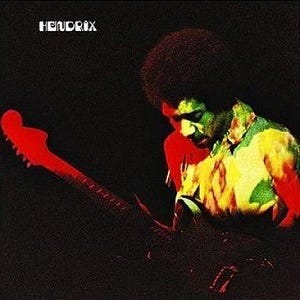
1970: American guitar virtuoso Jimi Hendrix releases his fourth album, “Band of Gypsys,” a live record featuring his new band, Band of Gypsys. It would be the last of his albums before his untimely death on September 18th of the same year. As with The Experience, Band of Gypsys are a power trio, comprised of bass player Billy Cox and drummer/vocalist Buddy Miles, along with Jimi.
Recorded on New Year's Day in 1970 at the legendary Fillmore East theatre in New York, the album is a mixture of R&B, funk, and some heavy blues jamming. The band had performed two shows on December 31, 1969 and then two more shows on January 1, 1970, with the entire album comprising tracks from the January 1st performances.
Hendrix produced the album himself and found it to be a difficult task due to the problematic recordings, and because the album would be released by Capitol Records instead of his usual label, Reprise, to satisfy a contractual obligation to his former manager, Ed Chalpin. Hendrix remarked after its release that he was not fully satisfied with the final product.
The album received mixed reviews from critics, with some correctly noting that Miles's drumming was not on par with The Experience drummer, Mitch Mitchell. Others praised the album, with AllMusic's Sean Westergaard writing in a retrospective review that, “...Band of Gypsys is one of the best live albums of all time and an important recording for Hendrix, who played with a remarkable degree of focus and precision on what were perhaps his finest [live] performances.” One thing all critics and audiences agree upon was that Hendrix's guitar playing was in peak form, particularly on the feature track, “Machine Gun.”
The album reached No. 5 on the Billboard 200, No. 5 on the Canada RPM Top Albums chart, No. 6 in the U.K., and was certified Platinum in the U.S.
1977: Emerson, Lake & Palmer release their seventh LP, the double-album “Works Volume 1.” Recorded mostly in Montreux and Paris in 1976, where the band reconvened as tax exiles following a long rest from their world tour of 1973's “Brain Salad Surgery,” it was a concept of sorts, wherein each band member is showcased per side, and the whole group collaborates on Side D.
Keith Emerson takes up Side A with his “Piano Concerto No. 1” in three movements. On Side B, Greg Lake showcases five acoustic ballads he co-wrote with lyricist Peter Sinfield, whom he previously collaborated with in King Crimson, and features the famous single, “C'est La Vie.” Carl Palmer takes Side C with his arrangements of classical pieces by Prokofiev and Bach, a re-production of “Tank” from the band's first album, but with orchestral arrangement and without the drum solo, and three original songs, including “L.A. Night” that features Joe Walsh on guitar. Finally, Side D is the band's prog-rock arrangement of Aaron Copland's “Fanfare for the Common Man,” and an original orchestrated piece, “Pirates.” Performing the orchestrations were London Philharmonic Orchestra on “Piano Concerto No. 1” and Orchestre de l'Opéra national de Paris, on “Pirates.”
Critics did not hate the album, but they were also not overly-impressed. Praising the full-band side, particularly “Fanfare for the Common Man,” and offering compliments on the Carl Palmer side, both Emerson and Lake received more criticism, with Emerson's concerto described as “...a good music-student piece, without much original language,” though it's really not that bad. Were critics expecting the second-coming of Tchaikovsky? Lake's “C'est La Vie” was criticized as a repeat of “Still...You Turn Me On” from “Brain Salad Surgery.” Contributing to the critical headwinds was the emergence of the punk-rock and new-wave scenes, with self-indulgent prog-rock odysseys viewed as the work of dinosaurs.
Not satisfied with just one “Works” record, the band would release “Works Volume 2” in November, 1977, a single-album compilation of leftover tracks from previous album sessions and the great Christmas song, “I Believe in Father Christmas,” and then “Works Live” in November, 1979, a performance of most of “Works Volume 1” from August, 1977 at Olympic Stadium in Montreal.
“Works Volume 1” is better than the critics claim, though by no means the best ELP record. It peaked at No. 12 on the Billboard 200 and was certified Gold in the U.S. and the U.K.
1972: “Machine Head,” the sixth studio album by hard-rock band Deep Purple is released to critical and commercial success. Recorded in December of 1971 in Montreux, Switzerland, it is the third album by the band's Mark II lineup of Ritchie Blackmore (g), Ian Gillan (v), Roger Glover (bg), John Lord (key), and Ian Paice (d), the only musician to perform on all Deep Purple records.
The original plan was to record the album at the Montreux Casino using The Rolling Stones' mobile recording studio, but that changed when the casino was set on fire by an audience member who shot off a flare gun during a performance by Frank Zappa & The Mothers, and “…burned the place to the ground.” The band managed to book the Grand Hotel (It was empty, cold, and bare) instead and proceed with the sessions, all of which is described in the lyrics to the first song on Side B, “Smoke on the Water.”
Reviews were glowing. The AllMusic rating is 5-Stars, MusicHound ranked it 5-Stars, and Christgau's Record Guide graded it B. Music fans embraced the LP warmly, sending it to No. 1 in the U.K., Australia, Canada, Netherlands, Finland, France, and Germany, and to No. 7 in the U.S., where it was certified 2x Platinum. It sold nearly three million copies worldwide.
For additional reading from the perspective of The Mothers, see this March 18th post from This Day in Music.
Legendary Birthdays
1949: Legendary Canadian record producer and keyboard player Bob Ezrin is born in Toronto, Ontario. Ezrin has produced albums for Lou Reed, Alice Cooper, Kiss, Pink Floyd, Deep Purple, Peter Gabriel, Phish, and many more. Happy 77th Birthday to Bob!
1947: Legendary British singer-songwriter and piano player Elton John is born Reginald Kenneth Dwight in Middlesex, England. Happy 79th Birthday to Elton!
1931: Legendary American record producer Tom Wilson is born in Waco, Texas. A Harvard graduate and resident producer for Blue Note, Columbia Records, and Verve Records, Wilson has produced works for Bob Dylan, The Mothers of Invention, Simon & Garfunkel, The Velvet Underground, Eric Bourdon and The Animals, and jazz artists Sun Ra, Cecil Taylor, Eddie Harris, and so many others. Remembering Tom, who died of a heart attack at only 47 years old in Los Angeles in 1978, on his birthday.
The Daily Elvis
1961: Elvis declares he will no longer do live concerts, dedicating his career to making movies. He would not perform live again for nearly eight years, until December 3, 1968 when he starred in his own TV special, nicknamed '68 Comeback Special, on NBC-TV.
Pictured: Band of Gypsys by Jimi Hendrix album cover.