This Day in Music
Dire Straits, The Who, Supertramp, Miles Davis, Simon & Garfunkel, and Elvis, on this busy day in music.

Releases
1984: British rock band Dire Straits releases its first contemporary live work, a double-album titled “Alchemy: Dire Straits Live.” Many of the pieces feature alternate arrangements and extended improvisations.
The songs were taken from the band's first four LP's, their first EP, and the track “Stargazer” from Mark Knopfler's soundtrack to the movie Local Hero, which is the uncredited beginning to the performance of “Once Upon a Time in the West” from their second album, “Communiqué.”
Reviewers criticized the record's slow and moody atmosphere and failure of the band to rile up the audience, but these aspects are what make the album great. It's an album for real fans who appreciate the subtleties of music, and outside of the boisterous drug-and-booze-addled concertgoers of North America, the fans were highly impressed.
The LP reached No. 3 on the U.K. Albums Chart, No. 3 in Australia and New Zealand, No. 3 in Switzerland, and went all the way to No. 1 in Netherlands. “Alchemy” not only turned lead into Gold in Europe and Australia, it turned it into Platinum in the U.K., Brazil, Netherlands, and New Zealand. This is a very good live record.
1979: Prog-light English rockers Supertramp release their sixth studio album, “Breakfast in America.” The LP capped-off a terrific four-record run, beginning with “Crime of the Century” (1974), then “Crisis! What Crisis?” (1975), and “Even in the Quietest Moments” (1977).
Critics got it wrong on this album, with no reviewer assigning it top marks, and some providing outright insulting ratings, including Robert Christgau of the Village Voice, who graded it a C+, and The Rolling Stone Album Guide ranking it only 3-Stars.
The listeners who really count, however, the record-buying public, knew better than the critics, judging the album to be spectacular through their actions. Three of the singles were Top-20 hits on the Billboard Hot 100: “The Logical Song” at No. 6, “Goodbye Stranger” at No. 15, and “Take the Long Way Home” at No. 10, with the fourth single, “Breakfast in America,” going to No. 6 in the U.K.
The album itself, on which every track is absolutely delightful, particularly the closing track, “Child of Vision,” went to No. 1 just about everywhere, including on the Billboard 200, and in Australia, Canada, Netherlands, France, New Zealand, Norway, Spain, and West Germany.
Commercial sales were brisk, earning the LP 4x Platinum certification in the U.S., Platinum in the U.K., West Germany, and France; and Diamond in Canada, where Supertramp always enjoyed its most resounding success. “Breakfast in America” has sold an estimated 20 million copies worldwide.
1981: The Who, those legendary and influential Mods from London, release their ninth studio album, “Face Dances.” It was the first of only two albums to feature drummer Kenny Jones, ex- of The Small Faces.
Reviews were across the spectrum: Rolling Stone rated it at the bottom with only 2.5-Stars; Robert Christgau of the Village Voice graded it a B+; and Record Mirror praised it with a 5-Star review.
The division was likely due to the change in sound, which was smoother and more sophisticated, attributed largely to the new drum sound and style. Kenny Jones, a supremely talented drummer in his own right, with his pitched, resonant drums, and traditional grooves, obviously wasn't going to sound like Keith Moon. But that also meant the record in some respects just didn't sound like The Who.
It is a good album though, and fans were excited to hear it, sending it to No. 2 on the Billboard 200 and No. 2 on the Canada RPM Albums chart. The lead single, “You Better You Bet,” went to No. 1 on the Billboard Mainstream Rock Tracks chart, and the album was certified Platinum in the U.S.
Ultimately, it was too soon following the death of Keith Moon, and too much of a musical departure for the The Who, to bring on a permanent drummer, and Townshend dismissed Jones in favour of up-and-coming session players who would mimic the patterns of Keith Moon when performing with the band. Most notably, the now-legendary Simon Phillips performed for their 25th Anniversary Tour in 1989, and the son of Ringo Starr, Zak Starkey, performed and recorded with The Who for 29 years, from 1996 to 2025.
Events
1971: At the 13th annual Grammy Awards, held at the Hollywood Palladium in Los Angeles, Simon and Garfunkel's masterpiece, “Bridge Over Troubled Water,” wins Record of the Year, Album of the Year, Song of the Year, Best Contemporary Pop Song, and Best Engineered Recording Non-Classical.
The Monday Miles
1956: At the legendary Van Gelder Studio in Hackensack, NJ, Miles Davis records his original tunes “No Line” and “Vierd Blues,” along with Dave Brubeck’s “In Your Own Sweet Way.” Accompanying Miles were Sonny Rollins (ts), Tommy Flanagan (p), Paul Chambers (b), and Art Taylor (d).
The songs would appear on Side B of the Prestige Records LP, “Collectors’ Items,” released in December of 1956. Side A of the LP consisted of the “The Serpent’s Tooth Take 1,” “The Serpent’s Tooth Take 2,” and “Compulsion” by Davis, plus Thelonius Monk’s “Round About Midnight” (no apostrophe and including “about;” see TDIM from March 4, 2026 for more details).
Jazz historian Ira Gitler wrote of the recordings, “The session of March 16, 1956 is one of most beautiful, laid-back, floating-on-a-cloud experiences one can have. The first time I listened to it, I replayed it three times.”
The Daily Elvis
1963: “One Broken Heart for Sale,” written by Otis Blackwell and Winfield Scott for the soundtrack to the movie It Happened at the World's Fair, and of course sung by Elvis in the film, peaks at No. 11 on the Billboard Hot 100.
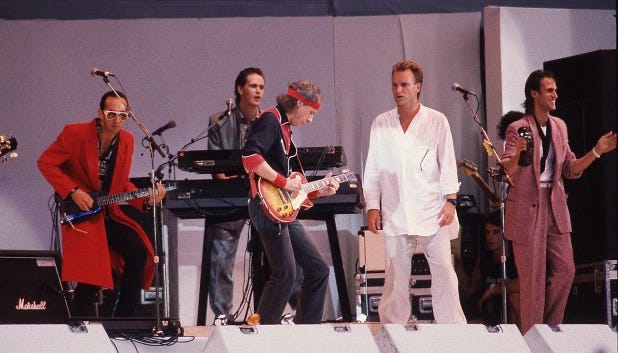
Pictured: Dire Straits performing “Money for Nothing” at Live-Aid in 1984, with Sting reprising his vocals from the album version.