This Day in Music
Honouring three legendary albums from three separate genres, and Elvis hits No. 1 for the first of four times, all on this day in music.

Releases
Progressive Hard Rock
1981: “Moving Pictures,” the seminal eighth studio album from Canadian hard-rockers Rush is released to widespread critical acclaim. After the success of their previous album, “Permanent Waves,” and the tour to support it, the band first decamped to Stony Lake, Ontario to write and arrange new songs based on ideas they had under development during the tour. Once the songs were ready, they then returned to the famous LeStudio in Morin Heights, Québec to complete the writing process, and record the new album.
The result was “Moving Pictures.” Though the band continued to move toward shorter, more radio-friendly songs, the record does include the fabulous 11-minute epic, “The Camera Eye.” All of the singles from the album would be huge rock radio hits: “Limelight,” “Vital Signs,” and of course, what would become their signature song, “Tom Sawyer,” which was written by the band and Pye Dubois, a well-known Canadian lyricist who co-wrote most Max Webster and Kim Mitchell solo songs. Though not released as singles, both “Red Barchetta,” and “YYZ” also received strong FM radio play.
Geddy Lee had been a guest on DJ Rick Ringer’s show on Toronto station CHUM-FM (which once upon a time was a rock station) on the night before its release, and played the album in its entirety. It became a huge commercial success, instantly going to No. 1 on the Canada RPM Top Albums chart, No. 3 on the Billboard 200, and No. 3 on the UK Albums list. It was certified 4x Platinum in Canada, 5x Platinum in the US, but for some unknown reason, only Gold in the UK. It would become the best-selling album of their career, and a favourite among fans and casual listeners.
It is also a legacy work, ranking No. 10 on Rolling Stone’s 2012 reader’s poll of Your Favourite Prog Rock Albums of All Time, and No. 3 on Rolling Stone’s 2015 list of 50 Greatest Prog Rock Albums of All Time, behind only Pink Floyd’s “Dark Side of the Moon,” and King Crimson’s “In the Court of the Crimson King.” The readers of Rhythm magazine voted “Moving Pictures” the Greatest Drumming Album in the History of Progressive Rock, and finally, Rolling Stone has ranked it No. 379 on its 2020 list of 500 Greatest Albums of All Time.
The album cover depicts the triple-entendre of the “Moving Pictures” title. On the front, pictures are being moved into an art museum while bystanders are being moved to tears by the emotional impact of the art. On the back cover, the entire tableau is revealed to be a “moving picture” scene in the making. The building on the cover isn’t an actual museum, it its the Ontario Provincial Legislature (which considering the number of dinosaurs that inhabit the inside, it might as well be a museum.)
Blues Based Rock and Roll
1972: Legendary American blues-rockers The Allman Brothers Band release the double-album, “Eat a Peach,” a combination of live and studio recordings. It is the fourth record in their canon.
Tragedy struck the band during the making of the album when founder and lead/slide guitarist Duane Allman died following a motorcycle accident on October 29, 1971 in Macon, Georgia, at only 24 years old.
Recording had begun in Miami, but following a short tour during which addictions within the band began to affect their performances, and Duane’s sudden death, upon their return to their base in Macon, GA, the group held a meeting to discuss their future. They decided to keep going. As drummer Butch Trucks remarked, “We all had this thing in us and Duane put it there. He was the teacher and he gave something to us—his disciples—that we had to play out.” They went back to Miami to complete the album.
And what an album! It features several tracks that became standards of their live performances for decades to come, including “Ain’t Wastin’ Time No More,” “Stand Back,” and “Melissa,” written by Gregg Allman, “Les Brers in A Minor” and “Blue Sky,” by Dickie Betts, Duane’s “Little Martha,” and covers of blues greats “One Way Out,” by Elmore James, and “Trouble No More,” by Muddy Waters.
Rounding out the album was the epic-length “Mountain Jam,” a 34-minute variation and improvisation on the melody to Donovan Leitch’s song, “There Is a Mountain,” that had been a staple in concert since the birth of the band, and featured Duane on slide guitar.
The piece had to be divided into two parts taking two entire sides of the album, Side Two and Side Four, due to the time limitations of vinyl LP’s, but with the CD release it is properly presented as one track. Subsequent reissues of the LP moved the two parts of “Mountain Jam” to Sides Three and Four of the album, with “Trouble No More” preceding Part 1 on Side Three, and “One Way Out” following Part 2 on Side 4. Three additional tracks were added, “One More Ride” at the end of Side One, and alternate versions of “Dreams” and “Statesboro Blues” at the end of Side Two. None of the additional tracks are listed on the album cover, though they do appear on the LP labels.
“Mountain Jam” was recorded on March 13, 1971 at the “Fillmore East” in New York. If you listen carefully to the very end of “Whipping Post” on the 1971 live album “At Fillmore East,” you can hear it segue into “Mountain Jam” as the record fades out. Given that “Whipping Post” is already over 22 minutes long, the band played for 57 minutes straight by the time “Mountain Jam” came to an end. Deluxe CD editions of “At Fillmore East” run the entire 57-minute jam without interruption.
“Eat a Peach” was the band’s most-successful release at the time, being outsold by their subsequent release, 1973’s “Brothers and Sisters,” then eventually overtaken by their prior release, “At Fillmore East,” peaking at No. 4 on the Billboard 200 and being certified Platinum.
Post Punk Modern Rock
1982: XTC, those post-punk modern rockers from Swindon, UK, release their fifth studio album, and first double-LP, “English Settlement.” With a modified sound that featured more acoustic guitar, 12-string electric guitar, and fretless bass, the album has been described as belonging to the pastoral movement of art.
Andy Partridge, co-founder, frontman, and principal songwriter, had been worn down by the constant touring imposed upon them by their management and the record company, so much so that he had suffered momentary amnesia during the “Drums and Wires” tour, forgetting the band’s songs, and even his own identity. On the “Black Sea” tour, they were supporting The Police, playing arenas and stadiums in Australia, New Zealand, and the United States, an arduous journey leading to a near-nervous breakdown for Partridge in the spring of 1981. He decided that a collection of tunes less-suited to live performance would deter the record label from demanding a tour.
The songs are therefore more intricate and longer than on previous XTC albums. The music reflects a wider range of styles, with writer Annie Zaleski remarking in 2017 for Diffuser.fm, the album “...rests stubbornly in between genres and resists pigeonholing.” She describes it as ranging from “caterwauling mod-pop,” to “buzzing synth-punk,” to “full-on ska-pop.” (Ed.: Annie does a far better job at writing about this album than I do, so please read her article here.)
Partridge’s frame of mind is revealed through the lyrics, which sing of broad, social issues, and get political with the song and first single off the album, “Ball and Chain,” a response to the economic policies of PM Margaret Thatcher. Two additional singles were spun-off, “Senses Working Overtime,” which became a Top-10 hit, and “No Thugs in Our House,” about a middle-class couple whose son is a violent racist.
The unique album cover reflects the pastoral nature of the music, being adapted from the Uffington White Horse, a 110-meter long prehistoric hill figure formed from deep trenches that are filled with crushed white chalk. The figure is carved into the upper slopes of Whitehorse Hill in Uffington (Oxfordshire), England, about 16 km east of Swindon.
The album peaked at No. 5 on the UK Albums list, No. 15 on the Canada RPM Albums chart, and No. 48 on the Billboard 200, and is still the most commercially successful album for the band. It was certified Silver in the UK.
The Daily Elvis
1957: The single "Too Much" becomes the first of four No. 1 songs for Elvis in 1957.
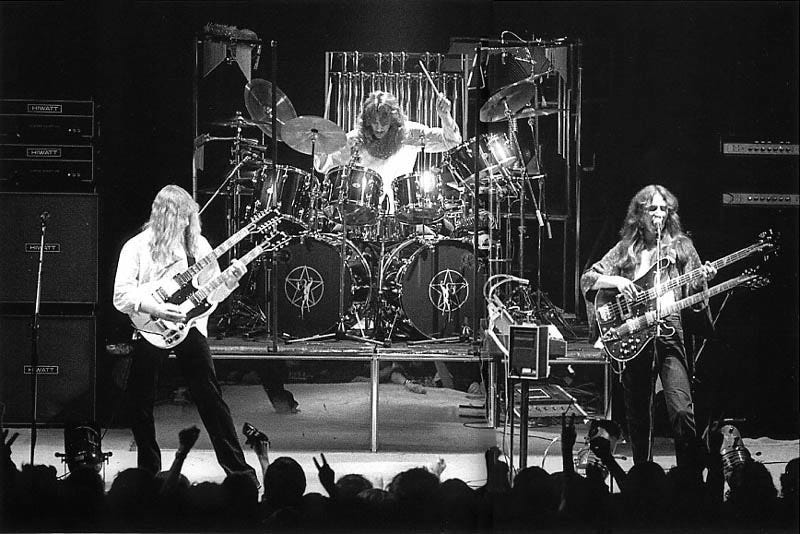
Pictured: Rush, with both Alex and Geddy playing double-neck guitars at the same time, which indicates they were likely playing "Xanadu.”
Post-Credit Scene - My Five Favourite Rush Albums
A Farewell to Kings
Moving Pictures
2112
Presto
Grace Under Pressure
Clockwork Angels
Yes, there are six albums on my Top-5 list.