This Day In Music
A rare reunion for a legendary duo, a rare grin from a legendary jazz cat, and the usual gold for Elvis, on this Family Day in music.

Releases
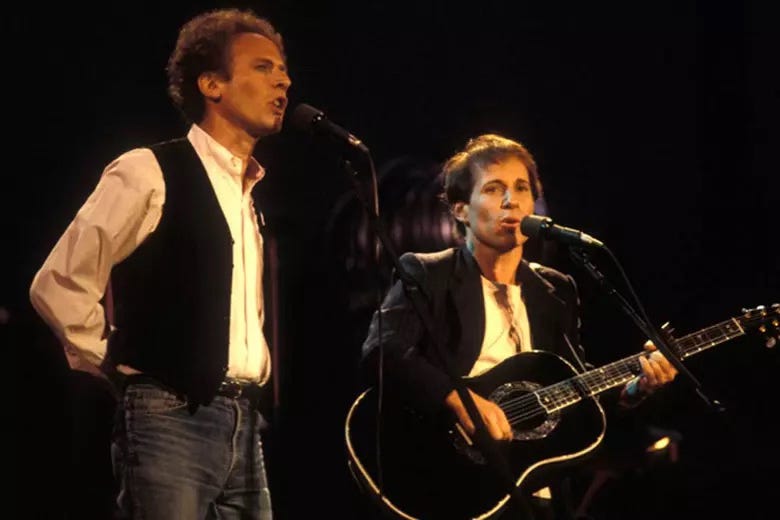
1982: American folk-rock duo Simon & Garfunkel release their first contemporary live album, “The Concert in Central Park,” a recording of their legendary performance from September 19, 1981.
By the early 1980’s, Central Park in New York had fallen into disrepair following years of neglect due to poor financial management by the City. The Parks Commission decided, based on successful concerts held in the park by Elton John and James Taylor, a benefit concert could raise some much-needed funds for a betterment program. In the summer of 1981, they chose to invite Simon & Garfunkel based on their popularity, prior success, and because they were life-long New Yorkers.
Paul Simon loved the idea, but was concerned that he could no longer draw a crowd following the commercial failure of his autobiographical movie, “One Trick Pony,” and that he and Garfunkel would not be able to work together. The idea was highly attractive to Garfunkel, who immediately returned from a vacation in Switzerland to begin preparations.
Though rehearsals opened old tensions between the pair, they persevered. On the day of the concert, it was expected that 300,000 people would show up to the Great Lawn for the show, but by 8:00pm officials estimated a turnout of over 500,000. Posters for the event had never announced “Simon & Garfunkel,” only that Paul Simon and Art Garfunkel would be performing. It was not until a week before the concert that officials confirmed the rumours that it would be a Simon & Garfunkel reunion show. Nonetheless, until the men walked on stage together and began singing the opening harmonies to “Mrs. Robinson,” some people doubted it would happen.
After closing out the show of 17 songs with “The Boxer,” the duo returned for an encore consisting of “Old Friends/Bookends Theme,” “The 59th Street Bridge Song (Feelin’ Groovy),” and of course, “The Sound of Silence.” After unexpectedly being recalled for a second encore, they once again played “Late in the Evening,” one of Simon’s solo songs that had been earlier performed as the 10th song in the set. Paul would later remark that he never really understood the magnitude of the event from the audience’s perspective: “I didn’t get what had happened – how big it was – until I went home, turned on the television and saw it on all the news ... and later that night on the front pages of all the newspapers. Then I got it.“
Both the concert and the LP were highly-praised by critics, with the exception of a dismissive Robert Christgau in the Village Voice, and commercially successful. The album peaked at No. 6 on the Billboard 200, No. 9 on the Canada RPM Albums chart, and No. 1 in Netherlands, France, New Zealand, and Norway. It was certified 2x Platinum in the US, and Gold in Canada. It is estimated to have sold over 5 million copies worldwide.
Following the concert, a re-invigorated Simon & Garfunkel embarked on a world tour in May of 1982. A subsequent new studio album was planned, but the pair soon found they could no longer work together, and the project was shelved with the Simon-written songs becoming his 1983 solo album, “Hearts and Bones.” Though the two would never be an official duo again, they would occasionally perform together, mostly at Simon’s concerts, beginning in 1990 for their induction into the Rock and Roll Hall of Fame. In 1993, they played a series of 21 sold-out concerts in New York, with Paul Simon and his band making up the first half of the show, and Simon & Garfunkel comprising the second half.
The Monday Miles
1967: Legendary jazz trumpeter, bandleader, and composer Miles Davis releases his 51st album, the stunning “Miles Smiles.” The album featured Miles’s “second great quintet,” comprised of Miles on trumpet of course, Wayne Shorter (ts), Herbie Hancock (p), Ron Carter (b), and Tony Williams (d). Released by Columbia Records and recorded at Columbia 30th Street Studio in New York, it was produced by long-time Davis collaborator, Teo Macero.
The collection of avant-garde be-bop and hard-bop jazz featured six tracks in total, with “Orbits,” “Dolores,” and “Footprints” composed by Shorter, the latter first appearing on his solo record, “Adam’s Apple.” The remaining three tracks are the Miles-written song “Circle,” and two contemporary standards, “Freedom Jazz Dance” by Eddie Harris, a favourite tune of Davis’s, and “Ginger Bread Boy” by Jimmy Heath.
Caught somewhere between be-bop and free jazz, the album explored more of Miles’s modal jazz stylings and featured less-formal meters and tempos. It’s often considered to be of the “post-bop” sub-genre, which musicologist Jeremy Yudkin defines as “an approach that is abstract and intense in the extreme, with space created for rhythmic and coloristic independence of the drummer—an approach that incorporated modal and chordal harmonies, flexible form, structured choruses, melodic variation, and free improvisation.”
Critics heaped near-universal acclaim on the record, with The Penguin Guide to Jazz rating it 4/4-Stars and AllMusic compiling a rating of 5/5-Stars. Interestingly, The Rolling Stone Album Guide rated it only 4/5-Stars, while The Rolling Stone Jazz Record Guide rated it 5/5-Stars. John Norris, editor of Canadian magazine CODA, remarked that the quintet “must be one of the most beautifully integrated groups ever to play jazz,” and who could argue with that? Afterall, it made Miles smile, and that is a rare moment indeed.
The Daily Elvis
1968: The RIAA awards Elvis a Gold record for his 1967 gospel album, "How Great Thou Art." It was a Top-10 album that also won the 1968 Grammy for Best Sacred Recording. It was ultimately certified 3x Platinum by 2010.
Pictured: Simon & Garfunkel on stage at The Concert for Central Park.