This Day in Music
Michael Fitzgibbon
Taking your hand in some strange Californian handshake and breaking the bone, a grand reunion, affirmative vibrations, and Elvis records for hours, all on this day in music.
Union
1991: “Union,” the 13th studio album from English progressive rock masters Yes, is released.
In 1988, following the tour for the 1987 Yes album, “Big Generator,” Jon Anderson, who had provided vocals on all Yes albums up to that point, with the exception of 1980’s “Drama,” decided once again to leave the band. He joined up with Bill Bruford (d), who had left Yes after 1972’s “Close to the Edge,” Rick Wakeman (key), who had been in and out of the band previously and had not been part of Yes since the 1978 release, “Tormato,” and Steve Howe (g), who had played with Yes on eight albums from “The Yes Album” in 1971 to “Drama.” Together, they formed Anderson, Bruford, Wakeman, and Howe (ABWH). They had intended to brand themselves as Yes, but were prohibited by Chris Squire (bg), the only musician to appear on all Yes albums at that time, and apparently the proprietor of the name.
Meanwhile, the original Yes had been reduced to a quartet consisting of Squire, Trevor Rabin (g; v), Tony Kaye (key), who had played on the first three Yes albums, “Yes” (1969), “Time and a Word” (1970), and “The Yes Album” (1971), then left and returned to the band for “90125” in 1983, and “Big Generator” in 1987, and Alan White (d), who had been on every Yes album since Bruford’s departure.
The album “Union” was intended to be the merging of Yes with ABWH into one giant, celebratory octet of Yes utopian bliss, featuring legendary members from past and present.
It did not succeed.
Disagreements by some of the musicians over the entire concept, most notably Bruford, strained relationships during the recording process, and most of all, the decision by Anderson and co-producer Jonathan Elias to bring in session musicians post-production to re-record some parts that Wakeman and Howe had already completed, made for an acrimonious experience. The album subsequently had ten different musicians credited with synthesizer and synthesizer programming.
Some of Bruford’s comments on the project included that it was, “…the most dishonest title that I've ever had the privilege of playing drums underneath,” “…single worst album I’ve ever recorded,” and “…a God-awful mess.” Sadly, Bruford is correct in each of those assessments.
The other problem with the album is that there was no actual union. On none of the tracks do all eight musicians appear together, and due to the difficulties between the personnel, they were hardly ever in the studio at the same time. The songs were compiled from incomplete ideas each band had been working on, with each band completing and recording their own songs without the other. The resulting double-album was poorly-rated by critics.
“Union” performed well in the charts however, largely on the excitement of the concept from the fans, reaching No. 15 on the Billboard 200, No. 7 in the U.K., and No. 15 in Canada. However, it sold only 500,000 copies - great success for most bands, but a disappointment for a project of this magnitude.
Though the ensuing tour of the octet was a generally positive experience for most of the players, Yes reverted back to its 1983 to 1988 lineup, i.e. Anderson (v), Squire (bg), Rabin (g), Kaye (key), and White (d), for the next album, “Talk,” in 1994. By 1996’s “Keys to Ascension I,” the lineup had changed yet again, but that’s a topic for a different day, likely October 28th, the anniversary of its release.
Rastaman Vibration
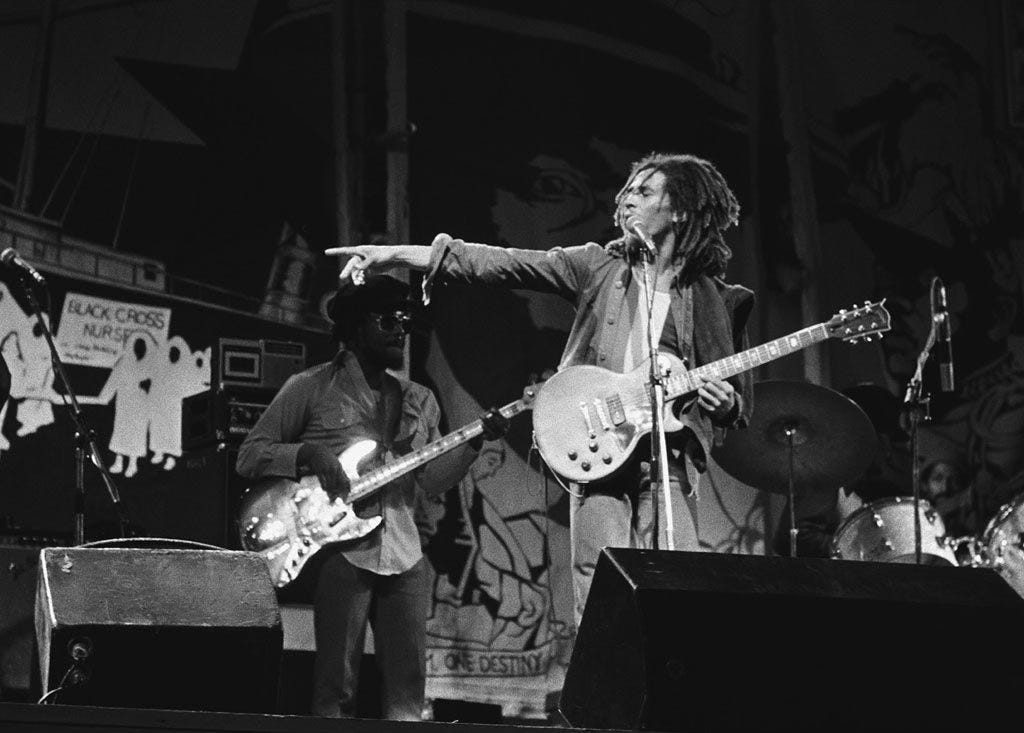
1976: Legendary Jamaican reggae band Bob Marley & The Wailers release their eighth studio album “Rastaman Vibration” to generally positive reviews. The band's reggae stylings were enhanced with greater use of synthesizers and Marley incorporating elements of rock guitar in his playing.
It was a commercial success in the U.S. and U.K. The album reached No. 8 on the Billboard 200, the first Wailers record to break the Top-10, and the single, “Roots, Rock, Reggae,” was the highest-charting song to date for the band, peaking at No. 51 on the Billboard Hot 100.
Also including the popular tracks, “Positive Vibration” and “Night Shift,” the LP was certified Gold in the U.S. and the U.K.
The Pros and Cons of Hitchhiking
1984: Ex-Pink Floyd co-founder, bassist, vocalist, and principal songwriter, Roger Waters, releases his first studio solo album, “The Pros and Cons of Hitch Hiking.”
A concept album centred on a man's disjointed thoughts during a mid-life crisis, it's presented as a fitful dream in real time that occurs between 4:30AM and 5:11AM, comprising the LP's 42-minute length.
The album's tracks are titled after the time in the dream that each event unfolds, with the prose title in parentheses. For example, the title track and tenth cut of the album, released as a single, is fully titled, “5:01AM (The Pros and Cons of Hitch Hiking, Part 10).” The first phrase of my preamble above is taken from the lyrics to this song.
Waters had initially conceived of the idea in 1978, and presented it with demos to his bandmates in Pink Floyd, along with a second concept with the working title, Bricks in the Wall, and asked them which would be preferable as a band project. Obviously, the band chose what would become “The Wall,” releasing it in 1979.
“The Pros and Cons of Hitchhiking” received wildly disparate reviews upon its release, with Rolling Stone rating it 1-Star, but AllMusic ranking it 4-Stars. Personally, I agree with AllMusic’s 4-Star rating. This is a good album, and I like it.
Commercially, it performed well, but nowhere near the sales volume of a Pink Floyd record. It was ultimately certified Gold in the U.S. and Silver in the U.K.
In addition to Waters, the LP featured several talented musicians including Eric Clapton on guitar, ex-Family Stone drummer Andy Newmark, and famous saxophonist David Sanborn.
Rock and Roll Criminal
1970: Twiggs Lyndon Jr., road manager for The Allman Brothers Band, was arrested on a charge of murder, after he stabbed and killed Angelo Aliotta, owner of Aliotta's Lounge in Buffalo, NY the night before in a dispute over Aliotta's refusal to pay $500 of the band's $1,000 fee for starting their first show late.
Lyndon's lawyer argued that Lyndon was temporarily insane because touring with The Allman Brothers Band would drive anybody crazy. Incredibly, the trial strategy succeeded, and Twiggs was acquitted.
In total, he spent 18 months in jail pre-trial, and six months in a psychiatric institution afterward, an egregious miscarriage of justice for a person who clearly committed second-degree murder, and should have served decades in prison.
Rock and Roll Prankster
1976: Keith Moon, the talented and infamous drummer for The Who, pays nine cab drivers $100 each to block off both ends of the New York City street Central Park South. He cleared the street so he could throw the entire contents of his room at the Hotel Navarro (now the Ritz-Carlton) out of the window!
Obviously it was wrong for Keith to engage in wanton destruction of property, but he at least had the sense to take precautions against injuring pedestrians.
The Daily Elvis
1957: At Radio Recorders in Hollywood, Elvis Presley records for over eight hours, putting together the soundtrack album “Jailhouse Rock” for his third movie. It’s also the session where Elvis first met legendary songwriting partners Jerry Leiber and Mike Stoller.