This Day in Music
Michael Fitzgibbon
Albums that ask questions, down despite up, and Elvis makes a stop in Topeka on his way to superstardom, on this day in music.
What’s Going On
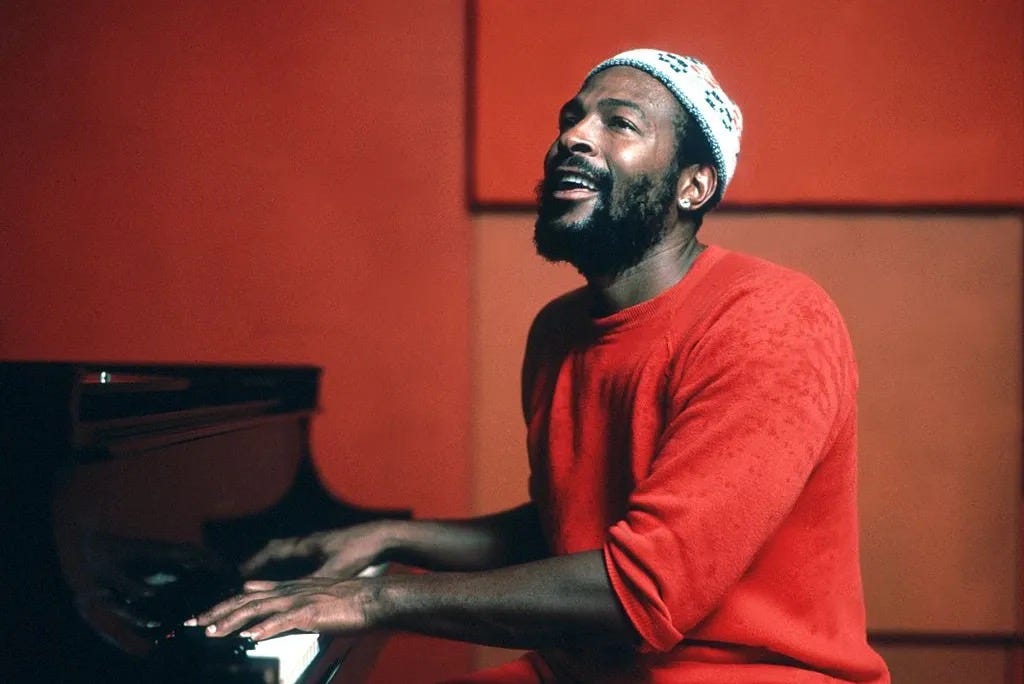
1971: Legendary American singer-songwriter and producer Marvin Gaye releases his eleventh studio album, the seminal “What's Going On.” It is the first of his own albums produced entirely by himself.
The LP features backing musicians The Funk Brothers and backing female vocalists The Andantes, both of whom were session groups for Motown Records. Also invited to participate in the album were members of the Detroit Symphony Orchestra's string, woodwind, and brass sections, the Detroit Lions football club, and Dave Bing of the Detroit Pistons basketball club on additional backing vocals.
A concept album with song cycles that gently segue from one to the next, it sings from the perspective of a Vietnam veteran returning home to witness the hatred, suffering, and injustices of early 1970's America, particularly Detroit, as well as ecological abuse, as explored on the aptly titled “Mercy Mercy Me (The Ecology.)”
Including the No. 1 hit single “What's Going On” along with eight other fabulous tracks, the album went to No. 1 on the Billboard Top Soul Albums chart, and was certified Gold. It features on several “all time” lists including the pinnacle position of No. 1 on Rolling Stone's 500 Greatest Albums of All Time (c) 2020. That's giving it a little too much praise, though it is indeed a grand musical achievement and awesome to listen to. It's also a legacy recording, added to the Library of Congress National Recording Registry in 2003.
OK Computer
1997: “OK Computer,” the third studio album from British semi-prog, semi-alt, semi-pop (can there be three semis?) band Radiohead, is released to universal critical acclaim and widespread commercial success.
Though not a fully-realized concept album, with it's lyrically-abstract themes of consumerism, social and modern alienation, emotional isolation, and political malaise in a future dystopian society, and in relation to technology, transportation, and globalization, it is a perspective into what was then the quickly-approaching 21st Century, but is now 30 years behind us. (What!?)
Receiving perfect marks from most music writers, the LP has sold nearly eight million copies for 5x Platinum certification in the U.K., 2x Platinum in the U.S., 5x Platinum in Canada, and 3x Platinum in Europe. Three of its singles made the Top-10 in the U.K. and other territories: “Paranoid Android,” “Karma Police,” and “No Surprises.”
It is ranked No. 42 on Rolling Stone's 500 Greatest Albums of All Time (c) 2020. I also think that’s too high of a position, though I do enjoy the record.
Why Do They Call Me Mr. Happy?
1993: Nomeansno, the Canadian punk band from Vancouver, release their sixth full-length studio album, “Why Do They Call Me Mr. Happy?” It's the second album released by the two-piece lineup of brothers Rob and John Wright, following the departure of Andy Kerr.
The record is a change from the band's hardcore punk sound, introducing elements of metal and prog.
Rated 4.5-Stars by AllMusic, it's also a favourite amongst Nomeansno fans. Additional musician Mark Critchley plays horns on the track “Cats, Sex, and Nazis.” I haven't heard this album in quite awhile, so today is a good day for me, and for everyone else, to revisit it.
Down on the Upside
1996: American hard rock (not grunge) band Soundgarden release their fifth studio album, and third consecutive double-album, “Down on the Upside.”
Critics were wildly split on the record, with Spin rating it 8/10 and NME ranking it only 3/10. Most other reviewers gave it a mediocre grade, exemplified by Rolling Stone's David Fricke, who wrote in his 3-Star star review, “Soundgarden seem to be digging in their heels rather than kicking up dirt.”
With two No. 1 singles on the mainstream rock charts, “Burden in My Hand” and “Blow Up the Outside World,” and “Pretty Noose” making it to No. 3, fans embraced the record, buying up over one million copies, for Platinum certification and No. 2 on the Billboard 200.
I like the album, though not as much as I like the Soundgarden releases “Superunknown” and “Badmotorfinger.”
It’s a good example of the downside (get it?) of issuing albums primarily on CD. The additional amount of data that can be stored provides for longer albums on a single disc, which tempts the musicians into filling up all that space. As a single LP, “Down on the Upside” would be a much better release.
The Daily Elvis
1956: A young man named Elvis Presley performs at the Topeka Municipal Auditorium in Topeka, KS. It was an opportunity for local media to capture images of the rising phenom.