This Day in Music
A little psychedelic ecstasy, recovering some long-lost recordings, and The King is singing gospel, all on this day in music.

Releases
1989: English modern rockers XTC release their ninth studio album (eleventh if one includes Dukes of Stratosphere albums), and second studio double-album, "Oranges & Lemons." Frontman Andy Partridge had set out to make a “very simple, banal-sounding record.” He failed in that endeavour, but that's okay because the resultant LP, which is a multi-layered and dense sonic experience, is nothing less than wonderful.
An eighties revisiting of pop-rock and psychedelia, peppered with broader musical styles of jazz, reggae, Middle-Eastern music, and soukous, a style of Congolese dance music originating in the 1960's, it was a more upbeat and aggressive work than its predecessor, "Skylarking," harkening back to the band's early-years sound and its two Dukes albums.
After the tensions and arguments with producer Todd Rundgren on "Skylarking," which did in fact result in a sublime record nonetheless, the band opted for producer Paul Fox for “Oranges & Lemons,” marking his first major production, with co-producer Pat Mastelotto, who also played drums on the album. Mastelotto was drummer with the band Mr. Mister at the time, and has now been with King Crimson for over 30 years.
After abandoning touring in 1982, XTC could focus on studio time and experimentation, integrating their interest in 1960's music increasingly into their sound, with both Dukes albums a representation of their psychedelic alter-egos, and "Skylarking" showing heavy 60's influences, all culminating in "Oranges & Lemons." Partridge remarked that he was inspired as much by The Beatles as by Captain Beefheart, which describes perfectly the sound of the record, a mixture of harmonic vocal pop with more eclectic and sophisticated sounds and arrangements.
The album's title is based upon the English nursery-rhyme of the same name, not, as some have suggested, a reference to the 1967 Pink Floyd single, "Apples & Oranges." Though none of the album's songs share the title, the lyrics “orange and lemon raincoats roll and tumble” appear on the song "Ballet for A Rainy Day" on "Skylarking."
The artwork is a psychedelic pop-art illustration of the band inspired by the cover art from The Who album, "A Quick One," and from The Beatles' "Yellow Submarine," an excellent representation of the music within.
Contemporary reviews of the album were highly-positive, with retrospective reviews providing even wider acclaim. Both Q and Record Collector rank it 5-stars. AllMusic compiles it at just under 5-Stars and published that the LP is “...sonically rich and filled with immaculately crafted songs.”
The lead single, "Mayor of Simpleton," performed modestly on British and Canadian charts, but peaked at No. 1 on the Billboard Modern Rock Tracks chart in the U.S. The album itself was the highest-charting release for the band since "English Settlement" in 1982, placing No. 28 on the U.K. Albums Chart and No. 44 on the Billboard 200.
This is an album every music collector should own, and once again furthers the mystery of why XTC did not achieve wider commercial success during their career.
1984: Queen releases their eleventh studio album, "The Works." Typical of Queen records during this period, it performed much better commercially in Europe than it did in North America.
All four of the album's singles reached the Top-10 in Europe, with "Radio Ga-Ga" and "I Want to Break Free" peaking at No. 1. Audiences in the U.S. and Canada however, were not as impressed, and the two songs never broke the Top-10, with "Radio Ga-Ga" coming close at No. 11 in Canada.
The album itself is modestly-rated, receiving no 5-Star reviews, and few 4-Stars. Its peak position in the U.S. was No. 23 on the Billboard 200, and in Canada it made it to No. 22 on the RPM Top Albums Chart. It went to No. 1 in Netherlands. It was certified Gold in the U.S. and Platinum in the U.K. and Canada.
Queen was not the same band in 1984 as they were just ten years earlier when they released the excellent “Queen II,” despite being the same lineup.
The Friday Frank
1996: “The Lost Episodes,” a compilation of previously-unreleased songs by legendary composer and musician Frank Zappa is issued posthumously by Rykodisc. The music was recorded from as early as 1958 in the case of “The Blackouts,” and as late as 1980 for “I Don’t Want to Get Drafted,” which was previously released as a non-album single that went largely unnoticed. It was re-recorded and appeared on the album “You Are What You Is” as “Drafted Again.”
Produced by FZ before his untimely death from prostate cancer in December of 1993, the collection features many rare tracks that fans had mostly only read about, including “Run Home, Slow,” which was the theme to the 1965 movie of the same name, directed by Ted Brenner, for which Zappa composed the music. A few tracks feature Frank’s friend from high school, Don Van Vliet aka the legendary Captain Beefheart, as co-writer and co-performer, including “Lost in a Whirlpool,” “Tiger Roach,” and “Alley Cat.”
The cover art was created by Hungarian illustrator and graphic designer Gábor Csupó, who co-founded the animation studio Klasky Csupo which produced many popular animated series, including the first three seasons of The Simpsons, Rugrats, and the cult-favourite, Duckman. Zappa’s elder son Dweezil voiced the character of Ajax on Duckman, a show that also used Frank’s songs in some episodes, including “Disco Boy,” “Help I’m A Rock,” and “Hungry Freaks Daddy.” Both Arlene Klasky and Gábor Csupó were FZ fans. (If you’ve never seen Duckman, which stars the voice of Jason Alexander in the title role, buy the DVD’s and watch!)
Other highlights of “The Lost Episodes” include “The Big Squeeze,” an advertising jingle written for Luden’s cough drops that won the Clio Award for Best Use of Sound; outtakes of “Inca Roads” and “RDNZL;” and the 1961 Pal Studio recording of “Take Your Clothes Off When You Dance,” which was re-recorded and released on the album “We’re Only in It for the Money” in 1968.
There are no official sales figures for “The Lost Episodes,” but based on typical distribution numbers for Rykodisc in the 1990’s, the package likely sold about 100,000 units. Most die-hard Zappa fans have purchased this album. (I’ve actually bought it twice, once on CD and once on MP3. If it ever gets a vinyl box-set release, I’ll buy that, too!)
The Daily Elvis
1967: "How Great Thou Art," the eighth non-soundtrack studio album by Elvis, is released. A collection of gospel songs, it features slow numbers on Side A, with upbeat tracks on Side B. It won the Grammy Award for Best Sacred Performance, and peaked at No. 18 on the Billboard 200. The record was certified 3x Platinum, and is a favourite among Elvis fans.
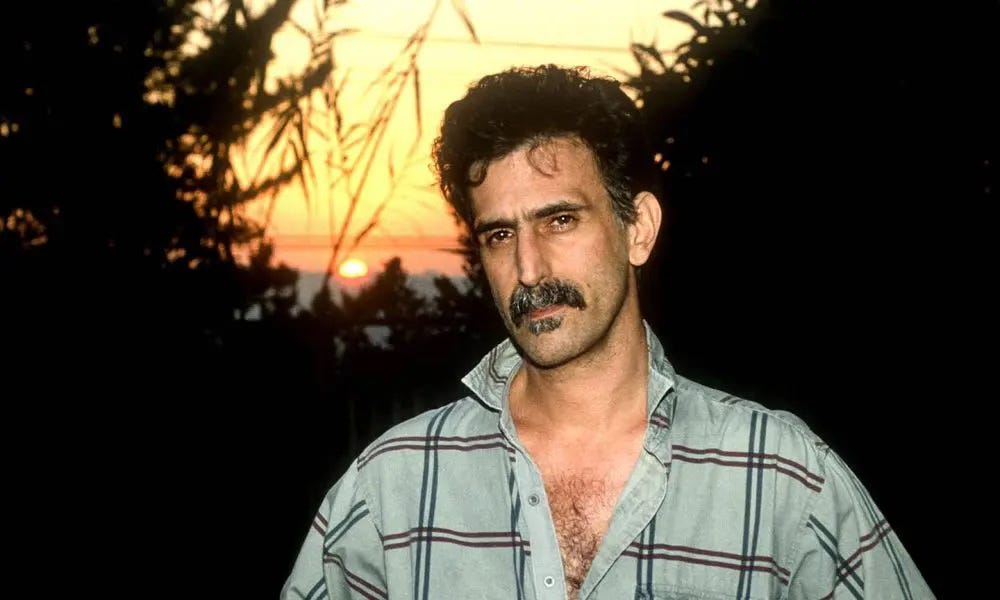
Pictured: Frank Zappa in a “Love Beach” kind of pose.