This Day in Music
February 3rd

I can't remember if I cried, when I read about his widowed bride, but something touched me deep inside, the day the music died. ~Don McLean, "American Pie." We remember a legend and Elvis is falling in love on this day in music.
People
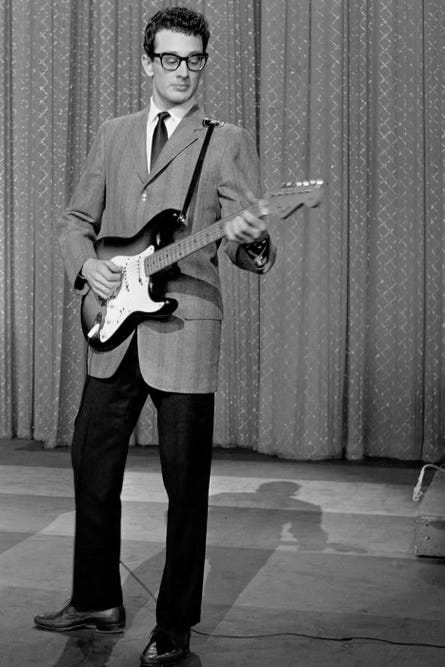
1959: Singer-songwriter and pioneering Rock-n-Roller, Charles Hardin Holley, better known as Buddy Holly, dies when his chartered Beechcraft Bonanza airplane crashes in an Iowa cornfield about eight kilometres northwest of Mason City. Fellow musicians Ritchie Valens and J. P. Richardson, aka The Big Bopper, also perished in the crash.
Buddy and his backing band of Waylon Jennings (bg), Tommy Allsup (g), and Carl Bunch (d), along with Valens, The Big Bopper, and newcomers, Dion and The Belmonts, were on the Winter Dance Party Tour, a revue with stops across the midwest including in Wisconsin, Iowa, Minnesota, and North Dakota.
The vast distances between venues was overlooked during the planning of the tour, making travel both difficult and exhausting due to long trips on short time. Exacerbating those challenges was the condition of the tour bus, which had no heater and had already broken down twice heading into the February 2nd show at the Surf Ballroom in Clear Lake, Iowa.
Drummer Carl Bunch had to be hospitalized for frostbite to his toes, prompting Holly to seek alternate transportation to the next performance. He chartered the four-seat Model 35 Bonanza aircraft from Dwyer Flying Service in Mason City for himself, Jennings, and Allsup. Jennings gave up his seat to the Bopper, who was ill with the flu, and Allsup agreed to flip a coin with Valens for the remaining seat. What seemed like a loss for Allsup, who called tails, would be the twist of fate that saved his life. He would later open a bar in Fort Worth, Texas named Heads Up Saloon.
Pilot Roger Peterson, who also died in the crash, took off in white-out conditions despite his lack of certification to fly instruments-only. In the early morning of February 3, 1959, shortly after 1:00am, en route to Fargo, North Dakota, the plane went down. One theory of the crash is that the inexperienced Peterson read the newly-installed Sperry Gyroscope incorrectly, and may have believed the aircraft was gaining altitude when in fact it was losing altitude.
The funeral for Holly was held in his home town of Lubbock, Texas, at the Tabernacle Baptist Church on February 7, 1959. It was officiated by the same pastor who only months earlier had married Holly to María Elena Santiago. Pregnant at the time of the crash, and first learning about it from TV news reports, the shock and stress caused Santiago to suffer a miscarriage, adding to the tragedy. Holly is buried in the City of Lubbock Cemetery.
Though he left us at only 22 years old, the impact of Buddy Holly on the culture was enormous. He left behind dozens of unfinished works, with his last-known recordings, made in his New York apartment in late 1958, becoming his final six singles, completed and released posthumously by his record company, Coral Records.
Holly influenced some of Rock and Roll’s biggest names, including Paul McCartney, John Lennon, Mick Jagger, Keith Richards, and Bob Dylan, all of whom were mesmerized after seeing him in concert. Elton John, The Clash, The Hollies, Eric Clapton, Grateful Dead, Bruce Springsteen, and of course Don McLean, all cite him as a significant influence on their songwriting and music careers, often covering his songs.
In his two-year recording career, Buddy Holly released three albums, one with The Crickets and two solo, and 28 singles, with ten of them reaching the Top-10, and four going to No. 1, including “That’ll Be the Day,” and “Maybe Baby.”
The number of artists who have covered Buddy Holly is too numerous to list, but one great example is “Not Fade Away” as done fabulously by Grateful Dead, The Rolling Stones, and Great Caesar’s Ghost.
Actor Gary Busey was nominated for both an Academy Award and a Golden Globe Award, and won The National Society of Film Critics Award for Best Actor following his portrayal of Holly in the 1978 bio-flick, “The Buddy Holly Story.”
As quoted in the preamble to this article, singer-songwriter Don McLean released a touching tribute to all three of the lost performers with special attention to Holly, “American Pie,” in 1971 that spent four weeks at No. 1 on the Billboard Hot 100 in early 1972.
February 3, 1959 was indeed the day the music died.
The Daily Elvis
1962: The Elvis single "Can't Help Falling in Love” peaks at No. 2 on the Billboard Hot 100.
Pictured: Buddy Holly with his iconic horn-rimmed glasses and Fender Stratocaster electric guitar.