This Day in Music
February 1st

Stars are on forty-five, the harvest comes in, and a double-dose of Elvis as he squeezes-in one last recording before shipping out, all on this very busy day in music.
Events
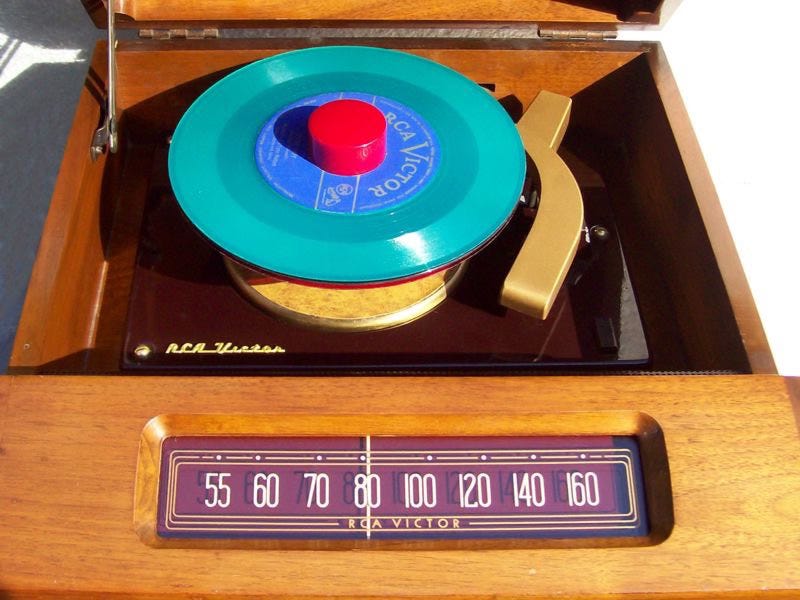
1949: Radio Corporation of America introduces the 7-inch 45-RPM micro-grooved vinylite record, i.e. “The 45,” through its subsidiary, record label RCA Victor.
Initially intended to replace RCA Victor's 78-RPM shellac discs, the ten years of development put RCA behind the curve and it was now competing with the 10" and 12" 33 1/3-RPM microgroove vinyl disc “Long Plays” (LP's) introduced by its chief rival, Columbia Records, the year before.
The early versions of RCA 45's were colour coded by genre: black vinyl for pop; broadway musicals and operettas on midnight blue; classical on red; country and polka on green; yellow vinyl for children's music; R&B on orange; and light-blue for international recordings.
Though Columbia's 10" and 12" LP's would capture the market for multi-track collections that required up to 50 minutes of playing time, the 45 reigned supreme as the medium for two-song releases, known as the “A/B Side Single.” 45's would wane in popularity throughout the 1980's, but are seeing a resurgence as part of the modern day vinyl revival. Some specialized modern re-issues are pressed on 12” vinyl, but spin at 45-RPM. These discs are still LP’s rather than 45’s.
1975: Miles Davis performs two shows at Festival Hall in Osaka, Japan, both of which are recorded for future release.
The first show was issued in August of 1975 as the live double-album “Agharta.” Three sides of the LP were committed to single pieces: “Prelude Part 1” on Side A, “Interlude” on Side C, and “Theme from Jack Johnson” on Side D, with “Prelude Part 2” and “Maiysha” sharing Side B. Critics raved about the album, with The Penguin Guide to Jazz rating it 4/4-Stars.
The second show was released in mid-1976 also as a live double-album and titled “Pangea.” This time, each of the two discs represents one musical piece, with “Zimbabwe Part 1” on Side A, and “Part 2” on Side B, then “Gondwana Part 1” on Side C, and its second half on Side D as “Part 2.”
Though not as critically acclaimed as “Agharta,” it was an excellent and highly influential album, particularly on the no-wave and funk scenes in New York City.
Releases
1972: Legendary Canadian singer-songwriter Neil Young releases his fourth studio album, "Harvest." Featuring songs inspired by his love interest at the time, actress Carrie Snodgrass, it has endured as his signature album and his highest-selling.
Personnel include all three members of Crosby, Stills & Nash, Linda Ronstadt, The London Symphony Orchestra, and his studio band, which he dubbed The Stray Gators, who also performed on his next album, "Time Fades Away."
A critical and commercial success, the record reached No. 1 on the Canada RPM 100 albums list, No. 1 on the Billboard 200, and No. 1 on the UK Albums chart. It was certified Diamond in Canada, 3x Platinum in the UK, and 4x Platinum in the US. "Harvest" was the highest-selling album in the United States in 1972, and has sold over 10 million copies worldwide.
1967: American folk-psychedelic band Jefferson Airplane release their second studio album, "Surrealistic Pillow." It was the first album by the band to feature Grace Slick on lead vocals and L.A.-area jazz cat Spencer Dryden on drums.
The record would go on to become one of the most influential of the psychedelic era and quintessential works of the pretentious late 1960's American counterculture.
Legend has it that Jerry Garcia of Grateful Dead is featured on several tracks. Though Garcia's appearance is denied by producer Rick Jarrard, he is credited on the RCA label copy.
With the hit singles "My Best Friend," "Somebody to Love," and "White Rabbit," the album performed well in the charts, peaking at No. 3 on the Billboard 200 and being certified Platinum.
Critics set the tone for what would ultimately be an overrated, but enjoyable album, earning a B+ in the Village Voice. It also placed No. 471 on Rolling Stone's 500 Best Albums of All Time, 2020 edition, a dramatic decline from No. 146 in the previous 2012 and 2004 editions.
1974: “It’s Too Late to Stop Now,” a live double album by Van Morrison is released to critical acclaim.
1994: Pop-punk American band Green Day releases their third studio album, and what would be their commercial breakthrough, “Dookie.”
1970: James Taylor releases “Sweet Baby James,” the 3x Platinum folk album that includes one of his biggest hits, “Fire and Rain.”
1973: “Aloha from Hawaii via Satellite” by Elvis Presley is released. The album is made up of live recordings from his concert of the same name, performed only the month before, on January 14th.
The Daily Elvis
1958: Elvis records "Wear My Ring Around Your Neck," his last studio appearance before his induction into the U.S. Army on March 24th.
Pictured: An RCA Victor 45 on an RCA Victor record-player/AM radio designed only for 45’s. Being light blue, it indicates an international recording. The spindle is the “stack” style, and another record, red for classical music, can be seen underneath the blue one.