This Day in Music
Two excellent LP's are overshadowed by a release of epic proportions, and Elvis is discharged, on this day in music.

Matter of Fact, It’s All Dark
1973: Legendary English psychedelic and progressive rock pioneers Pink Floyd release their eighth studio album, “The Dark Side of the Moon.” A concept album about the stress of the band’s lifestyle and the mental health problems of departed co-founder Syd Barrett, it explores themes of conflict, greed, time, and death.
There is some ambiguity about the title of the album. Is it “The Dark Side of the Moon,” or just “Dark Side of the Moon?” There is no title printed on the album, but the last line of the song “Brain Damage” is “I’ll see you on the dark side of the moon.” That doesn't necessarily put a “the” in the title, but this blog will nonetheless henceforth refer to the album as “The Dark Side of the Moon.”
With all lyrics and most of the music written by Roger Waters, development of the songs began during live performances and eventually moved to EMI Studios in London (now Abbey Road Studios) in May of 1972 to begin recording, a process that lasted on and off until February, 1973. The 1974 re-release of Pink Floyd’s concert film, “Pink Floyd: Live at Pompeii” features video of the Abbey Road recording sessions, including Nick Mason ordering breakfast in the cafeteria: “I’ll have eggs, sausage, chips and beans, and a tea.”
The album was engineered by Alan Parsons, who employed the use of analog synthesizers and tape loops to achieve the soundscapes and voices present throughout the record. Parsons was also responsible for recruiting session singer Clair Torry, famous for her vocals on “Great Gig in the Sky.” Torry eventually earned a songwriting credit on the track as her improvised vocals are some of the song’s melodies. For his work, Parsons received a Grammy nomination for Best Engineered Recording, Non-Classical. Four additional background vocalists were called upon, and saxophonist Dick Parry was engaged for the solos on “Money” and “Us and Them.”
“The Dark Side of the Moon” is one of the most critically acclaimed and universally-adored albums in the greater rock genre, along with being among the most influential. The band earned international fame and fortune from the record, with each member lauded for his specific contributions. That doesn’t mean it was free of critique. Robert Christgau (naturally) wrote in his seventies record guide that the lyrics were clichéd and the music was pretentious, nonetheless referring to it as a “kitsch masterpiece” and assigning it a rating of B. Most other review sites have properly ranked it at full scale, including AllMusic, The Rolling Stone Record Guide, and Billboard, all of which graded it 5-Stars.
The popularity of the album meant worldwide commercial success. Peaking at No. 1 in the U.S., Canada, Austria, and Italy, it placed Top-3 in Australia, Finland, Netherlands, Germany, New Zealand, Norway, Spain, and U.K. With estimated sales of 45 million units, it is the fourth-highest selling album of all time, and has astounding certifications: 15x Platinum in the U.S., Double Diamond in Canada, 16x Platinum in the U.K., 14x Platinum in Australia, and 16x Platinum in New Zealand, among Platinum and multi-Platinum awards in several other countries. Excluding movie soundtracks, “The Dark Side of the Moon” is the third-best selling album of all time, behind AC/DC’s “Back in Black” and Michael Jackson’s “Thriller.”
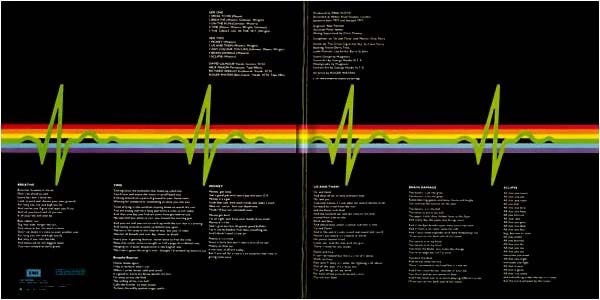
The original packaging for the LP was a gatefold jacket designed by Hipgnosis, an arthouse that had worked on several other albums for the band (and for many other recording artists), including the albums “Atom Heart Mother” and “Obscured by Clouds,” both of which displeased Capitol Records, though they are excellent LP covers. For Dark Side, the design was meant to be “smarter, neater; more classy” in the words of Richard Wright. The iconic light-splitting prism against an all-black background was the result. The spectrum of light continues throughout the gatefold, with added, regular peaks and valleys for green, representing heartbeats displayed on a heart monitor. The album opens and closes with a bass drum mimicking the sound of a heartbeat.
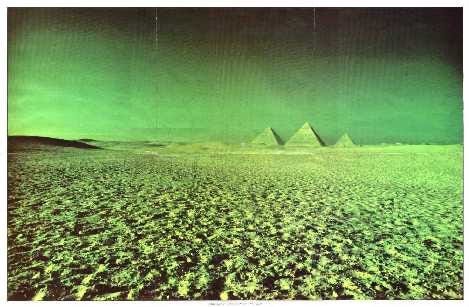
Included with the LP were two posters, one of the band itself in concert, and the other was an infrared photograph of the great pyramids at Giza. Two pyramid-themed stickers were also included. For the 2003 180g audiophile vinyl re-release of the album, the entire packaging extravaganza was recreated.
“The Dark Side of the Moon” often ranks highly, if not at No. 1, on various all-time best lists, and is one of those albums that just about every record collector owns. It ranks No. 55 on Rolling Stone’s 500 Greatest Albums of All Time c.2020, and No. 1 on Rolling Stone’s Best Progressive Rock Albums of All Time. It was also a favourite laser light show accompaniment at planetariums throughout the world right into the 2000’s. In 2013, “The Dark Side of the Moon” was added to the United States’ National Recording Registry in the Library of Congress as “...culturally, historically, or aesthetically significant.” It was voted No. 9 for Colin Larkin’s All Time Top 1000 Albums c.2000, and finally, music video channel VH1 rated the LP’s cover the fourth-greatest of all time.
Releases
1993: Choosing a poor date for the release of a great record, Sting issues his fourth studio solo album, the awesome "Ten Summoner's Tales.” The title is a play on Sting's real last name of Sumner, and Chaucer's magnum opus collection of stories, The Canterbury Tales. (Though there are actually 24 Canterbury Tales and 12 tracks on the album.)
Reflecting a much brighter and upbeat atmosphere than his previous excellent release, "The Soul Cages," the record sings of love and morality. Acclaimed by critics and embraced by fans, it peaked at No. 2 on the Billboard 200, No. 3 on the Canada RPM Albums Chart, and was No. 1 in Austria.
All seven of its singles made the Top-40 in at least one jurisdiction, with "If I Ever Lose My Faith in You" going to No. 1 in Canada. The LP (yes, it's still a “long play” even though the original format was CD) was certified 3x Platinum in the U.S., 2x Platinum in the U.K., and Platinum in Canada.
1990: Also inadvertently choosing to be overshadowed on future album anniversary commemorations, except for this blog of course, Canadian blues-rockers Cowboy Junkies release "The Caution Horses," their third studio album.
Unable to conceive that the band was not going to make an identical album to its predecessor, “The Trinity Sessions,” critics unfairly gave the album a tepid reception. Fans had a different reaction however, with many of its tracks receiving regular radio play, including "Sun Comes Up, It's Tuesday Morning," the covers "Powderfinger," by Neil Young, and "You Will Be Loved Again," by Mary Margaret O'Hara, along with what would become a late-night concert staple for the band, the fabulous blues lament, "'Cause Cheap Is How I Feel."
The album peaked at No. 11 in Canada, where it was certified Platinum. It went to No. 10 in Norway.
The Daily Elvis
1960: Sgt. Elvis Presley is transferred out of Company D, 32nd Tank Battalion, 3rd Armour Corps, and provided an honourable discharge from the United States Army, with a “Farewell Elvis” press conference in West Germany.
Pictured: The Dark Side of the Moon inside gatefold design and the infrared image of the Great Pyramids for the accompanying poster.