This Day in Music
Michael Fitzgibbon
Brothers in music times two, lumps in the gravy, and Elvis praises the Lord, on this day in music.
Brothers In Arms
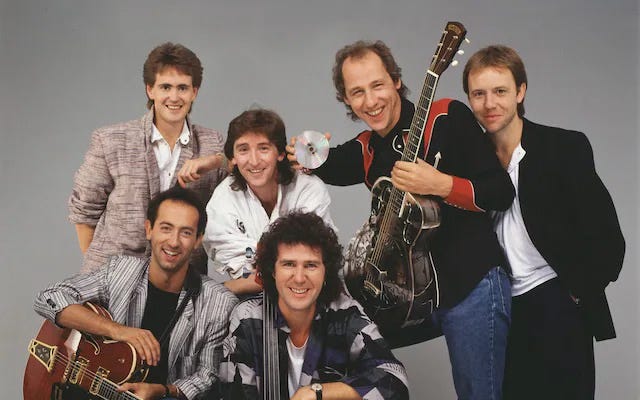
1985: Classic British Rock and Roll band Dire Straits release their fifth studio album, “Brothers in Arms,” to massive commercial success. The first album in history to sell over one million copies just on CD, it eventually sold over 30 million units on all formats combined.
The album was No. 1 for 14 non-consecutive weeks in the U.K., nine weeks at No. 1 on the Billboard 200, and was 34 weeks at No. 1 in Australia, on its way to being No. 1 all across Europe and in Canada. It is the 26th best-selling album in history (20th when excluding greatest hits packages and multi-artist movie soundtracks), and the 8th best-selling in the U.K. The LP was certified 10x Platinum in the U.K., 9x Platinum in the U.S., Diamond in Canada (i.e. 10x Platinum), and 17x Platinum in Australia.
“Brothers in Arms” was one of the first digitally recorded records, using a 24-track Sony DAT console, a contributing factor to the quality of the CD sound, as opposed to analog records reissued on CD.
Also contributing to the success of the album was the popular video for the single, “Money for Nothing,” which was in heavy rotation on MTV and similar services around the world, including being the first video ever aired by MTV Europe upon its launch on August 1, 1987. It’s likely no coincidence that MTV enjoyed the opening chant, sung by Sting, of “I want my MTV,” the slogan used by the TV service at that time.
No strangers to video, Dire Straits had made a cinematic trilogy designed and directed by Lester Bookbinder five years earlier. The songs were “Tunnel of Love,” “Romeo and Juliet,” and “Skateaway,” which formed Side A of the album “Making Movies,” my favourite Dire Straits record. The videos were often played individually or in sequence between movies on premium cable channel First Choice in Canada.
Though the album featured many great tracks, including “Money for Nothing,” “So Far Away,” “Brothers in Arms,” “Your Latest Trick,” and “Walk of Life,” critics were split in their ratings. For example, Record Mirror assigned the LP a 1-star rating (!), while Q accurately reviewed it as a 5-star release.
Nonetheless, it went on to receive numerous accolades, including the 1986 Grammy Award for Best Engineered Album Non-Classical, a ranking of No. 418 on Rolling Stone’s 500 Greatest Albums of All Time (c) 2020, and inclusion in Larkin’s 1001 Albums You Must Hear Before You Die.
Lumpy Gravy
1968: “Lumpy Gravy,” the third studio album by American avant-garde composer Frank Zappa is released. Accompanying Zappa on this record was the Abnuceals Emuukha Electric Symphony Orchestra, a collection of Hollywood session players put together by Zappa.
Several of the regular members of The Mothers of Invention were also part of the orchestra or chorus, including Jimmy Carl Black, Bunk Gardner, and Roy Estrada. The Abnuceals Emuukha Electric Symphony Orchestra would again appear on 1979’s “Orchestral Favourites,” with FZ’s 1975 touring band supplementing the Hollywood musicians.
“Lumpy Gravy” features two pieces of musique concrète, compositions that include recorded sounds as raw material, “Lumpy Gravy Part I” and “Lumpy Gravy Part II,” augmented by the orchestral performances, surf music, and spoken word clips. Both the music and the editing of the LP received praise from critics.
A dense and complicated score with variable time signatures, not all of the musicians were receptive to it, with bassoonist Don Christlieb and bass clarinetist Gene Cipriano refusing to perform their parts, claiming them to be impossible to play. Zappa made a deal with them, saying, “If I play your part, will you at least try it?” FZ showed them how to play it, they tried, and they succeeded.
One of the percussionists did not take the music seriously at first, believing Zappa to simply be “some rock musician,” however, after reviewing the score and observing Zappa lead the orchestra, he gained a large measure of respect for the young composer. That percussionist? The great Victor Feldman.
Obviously not the kind of work to get regular play on pop radio, the album nonetheless reached No. 159 on the Billboard 200 due to its popularity among FZ fans.
Paint It Black
1966: The Rolling Stones release their 20th single, “Paint it Black.” Only the second Rock and Roll song known to use a sitar, after “Norwegian Wood” by The Beatles, it peaked at No. 1 in the U.S., U.K., and Canada, selling nearly three million copies.
As of 2026, the Stones have released 124 singles, the most recent of which, “In the Stars,” came out just last week, fully 60 years after “Paint It Black.” Those Stones just keep on rolling, and will release their 25th studio album on July 10th, titled “Foreign Tongues.”
Brother Where You Bound
1985: English pop-progressive-rock band Supertramp release their eighth studio album, “Brother Where You Bound.” Though the album was poorly rated by critics upon release, the negative reviews were unfounded as it is an excellent album, and a big improvement over 1982's “...Famous Last Words.”
Retrospective reviews are much more favourable, praising the album also for its sound quality and strong performance by guest musician David Gilmour. A return to the band's progressive roots, and the first record since co-founder Roger Hodgson left the band in 1983, it features the standout 16:30-long epic track “Brother Where You Bound,” among lyrical themes that reflect the Cold War tensions of the day.
The great lead single from the LP, “Cannonball,” reached No. 9 on the Billboard Dance Club Chart! A Gold-certified record, “Brother Where You Bound” went Platinum in Canada, where Supertramp enjoys strong popularity because Canadians obviously have great taste in music.
The Daily Elvis
1967: The eighth studio album from Elvis, and second LP dedicated entirely to Gospel music, "How Great Thou Art," reaches No. 18 in the U.S. and No. 11 in the U.K.