This Day in Music
Michael Fitzgibbon
Going to heaven on a flock of seagulls while dodging spaceships, and Elvis is living Las Vegas, on this busy day in music.
The Chicago Transit Authority
1969: Midwestern rockers with a horn section and jazz sensibility, The Chicago Transit Authority, burst onto the scene with their debut studio LP, a double-album titled, “Chicago Transit Authority.”
While it did not get much notice upon its release, it gained fans slowly over time, and by 1971 it peaked on the Billboard 200 at No. 17, spawning several successful singles along the way to becoming the record-holder for most consecutive weeks on the chart at that time, at 171.
Interestingly, by the time CTA peaked, the band had already released their second and third studio LP's, both of them also double-albums. The second album single, “Colour My World,” was the B-Side to the re-released first album single, “Beginnings,” to take advantage of the LP’s growing popularity. The group would shorten their name to just Chicago beginning with the second album following legal threats from the real Chicago Transit Authority, i.e. the City of Chicago's public transit commission.
Featuring a number of great tracks with powerful horn arrangements, including “Introduction,” “Does Anybody Really Know What Time It Is?,” “Beginnings,” “Questions 67 & 68,” and a great cover of The Spencer Davis Group's “I'm a Man” with a drum solo by Danny Serafin, it was a landmark album in the jazz-rock, not fusion, genre.
If I ever get around to compiling a list of my 100 favourite albums, this record will definitely make the cut.
Together Through Life
2009: “Together Through Life,” the 33rd studio album from legendary American singer-songwriter Bob Dylan is released. Arriving without prior notice or promotion, the folk and blues record came as a surprise to fans, and a pleasant surprise at that.
Receiving widespread critical acclaim, it was also a commercial success, peaking at No. 1 in the U.S., Canada, U.K., Scandinavia, and several other territories. Worldwide, it sold over one million copies.
It's an excellent late-career release by Dylan, who recognized that at his age, gravely-voiced blues was the best style to showcase his continuing lyrical talents. Some of the highlights are the tracks “Beyond Here Lies Nothin',” “Forgetful Heart,” “Jolene” (an original song; not a cover of the Dolly Parton song of the same name), and “It's All Good.”
Powerage
1978: AC/DC releases their fifth studio album, “Powerage.” Considered among the best of the band's output, the hard-rocking record includes none of their most-famous songs, but all the tracks are powerful deep cuts that make for an excellent album. It was certified Platinum in the U.S. and 3x Platinum in Australia.
A Flock of Seagulls
1982: “A Flock of Seagulls,” the debut studio album by the British new wave band A Flock of Seagulls is released.
Well-rated by most critics, including earning an A- from Robert Christgau of the Village Voice, it was also a commercial success. It peaked at No. 10 on the Billboard 200, and went to No. 5 in Canada.
Spinning out two hit singles, “I Ran (So Far Away),” which hit No. 1 in Australia, and “Space Age Love Song,” which went to No. 30 on the Billboard Hot 100, it has become a ubiquitous 80's Album that is always featured in 80's-themed collections and dance parties.
Go to Heaven
1980: San Francisco jam rockers Grateful Dead release their eleventh studio album, and 16th official album overall, “Go to Heaven.” With a cheeky cover photo of the band in all-white suits under soft focus, the LP features what would become the concert staples “Alabama Getaway” and “Althea.”
Other notable tracks include “Feel Like a Stranger” and “Easy to Love You,” the latter co-written by long-time band lyricist John Perry Barlow and new keyboard player Brent Mydland, who joined in 1979 following the departure of Keith Godchaux. He would become the Dead’s longest-serving keyboardist.
The album peaked at No. 23 on the Billboard 200, which was a strong commercial success for Grateful Dead. Though it’s a pleasant listen, it received tepid reviews from critics, and is not one of the band’s classics.
Argus
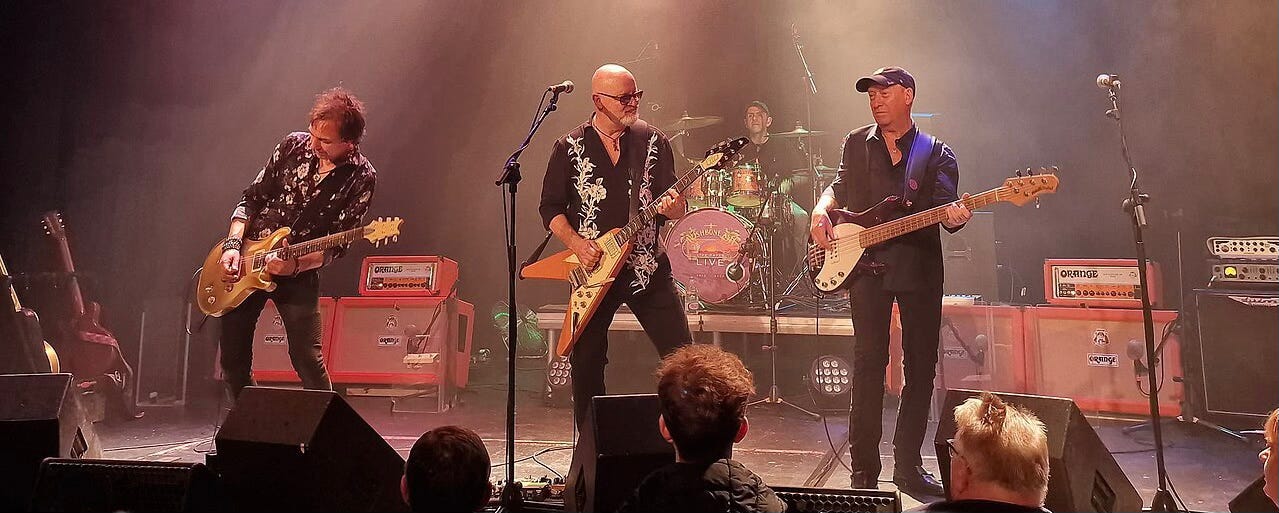
1972: Blues-rockers from Torquay (Devon), England, Wishbone Ash, release their third studio album, the seminal progressive rock classic, “Argus.” Fun fact: The 1970’s British sit-com Fawlty Towers is set in Torquay.
A landmark album in the use of twin guitar harmonization, it was engineered by Martin Birch, who would go on to be a famous producer of hard rock and metal acts including Deep Purple, Black Sabbath, and Iron Maiden.
Though the LP is not a concept album, many of the songs on “Argus” reflect the medieval period and Greek mythology, especially on Side B with tracks like “The King Will Come,” “Warrior,” and “Throw Down the Sword.”
The not-quite-a-concept LP was a hit with audiences, making the record the most critically well-received of the band’s career, ranking 4-Stars at AllMusic and 5-Stars at SputnikMusic. Sounds magazine chose “Argus” as its Album of the Year in 1972. Steve Harris of Iron Maiden was quoted in Guitar World magazine in 2011 saying, “…if anyone wants to understand Maiden's early thing, in particular the harmony guitars, all they have to do is listen to Wishbone Ash's Argus album.”
The record was the most commercially successful of Wishbone Ash’s career, reaching No. 3 on the UK Albums List and earning Gold certification.
Famous graphic designers Storm Thorgerson and Andy Powell of arthouse Hipgnosis created the record’s artwork. With photography taken at Gorge de Verdon in France, it depicts a warrior in garb that could be futuristic or ancient, gazing across the landscape as a spaceship emerges from the clouds in the distance. The design so impressed Jimmy Page of Led Zeppelin, he commissioned Hipgnosis to do the artwork for “House of the Holy.” It was rumoured that the warrior on the album cover was the inspiration for George Lucas’s Star Wars antagonist, Darth Vader.
The Daily Elvis
1964: The Doc Pomus-Mort Shuman song, “Viva Las Vegas,” as performed by Elvis in the movie of the same name, is released as a single. Though one of his most famous numbers, it only reached No. 29 on the Billboard Hot 100 and he never performed it live.