This Day in Music
Michael Fitzgibbon
The aftermath of driving a hot rod and Elvis is at The International Hotel, all on this day in music.
Aftermath
1966: The greatest Rock and Roll band in the world, The Rolling Stones, release their sixth studio album, “Aftermath,” in the U.K. The U.S. release would arrive in late June and offer a different track listing and sequencing, as was the usual practice for the Stones in those days.
With 14 songs instead of eleven, and including two of the Stones' greatest all time singles in “Mother's Little Helper” and “Out of Time,” the U.K. release is the better of the two. In fact, it’s one of my favourite Rolling Stones albums.
The great tracks don’t stop there. The record also includes “Stupid Girl,” “Lady Jane,” “Under My Thumb,” “Take It or Leave It,” and “Goin’ Home,” the longest Stones song at 11 minutes, 18 seconds.
The U.S. release would include the legendary “Paint It Black” in place of “Mothers Little Helper,” and places “Think” as the sixth song on Side A instead of “Goin’ Home,” which is song five on Side B. The songs “Take It or Leave It” and “What to Do” are left off of the U.S. release altogether (along with “Out of Time” as noted above).
The Stone’s U.S. label, London, was wrong to change the record from its original U.K. presentation.
Considered an artistic breakthrough for the band, it was the first Stones album of all original material, with songs credited to Jagger-Richards. Brian Jones contributes much of the character by playing instruments not usual to rock, including sitar, Appalachian dulcimer, Japanese koto, marimba, and vibraphone.
Widely considered to be the Stones' best record to that date, and their first classic, it was highly regarded by critics. Interestingly, the Encyclopedia of Popular Music ranks the U.K. version at 4-Stars, but the U.S. version at 3-Stars, though it should be 5-Stars and 4-Stars respectively. The LP received 5-Star ratings from Blender and The Rolling Stone Album Guide, and returned an AllMusic rating of 5-Stars.
Commercially, it was a huge success, going to No. 1 on the Billboard 200, No. 1 on the U.K. Record Retailer LP chart, and No. 1 on Canada's CHUM's Album Index. The LP is also a legacy recording, appearing on many all-time lists including No. 108 on Rolling Stone's 500 Greatest Albums of All Time (c) 2003. “Aftermath” is certified Platinum in the U.S. (the U.S. version) and Gold in the U.K. (the U.K. version).
Back to the song “Out of Time,” it is one of my favourite Stones tunes. The full 5:15 album version, which only appears on the U.K. release of “Aftermath,” is one of the band’s best tracks. The edited 3:41 version available on the compilation albums “Flowers” and “More Hot Rocks (Big Hits & Fazed Cookies),” doesn’t do the song justice.
Second Helping
1974: Jacksonville, Florida’s Lynyrd Skynyrd release their second studio album, “Second Helping.”
Receiving mostly positive reviews, rock journalists generally thought of the band and the album as a less-sophisticated version of The Allman Brothers Band, much to the chagrin of Skynyrd. Truth be told, those critics are correct, but it’s unfair to Skynyrd to make those comparisons solely on the basis that both bands were erroneously labeled “southern rock.” Very few American bands were better than the ABB.
The hit single from the record is “Sweet Home Alabama,” a guitar-led song with a great hook that features a stanza which supposedly defends the South from a critique of its racial inequality by Neil Young in his song, “Southern Man.” Skynyrd provides no details of a defence, they only sing that “Southern man don’t need him (Neil Young) around anyhow.”
Young’s assessment of the lingering effects of slavery and Jim Crow segregation laws were valid. It’s important to note in 2026 that “Southern Man” was released in 1970. It was only three years after Loving v. Virginia, which struck down anti-interracial marriage laws; only five years removed from The Voting Rights Act; and six years after The Civil Rights Act. The South is a much different place today.
That catchy guitar hook plus gospel-like background vocals propelled “Sweet Home Alabama” to the Billboard Top-10. As for the album, “Second Helping” was a huge commercial success, rising to No. 12 on the Billboard 200 and going 2x Platinum. It includes two other famous tracks, “The Ballad of Curtis Loew” and “Call Me the Breeze,” originally by J.J. Cale.
Well-rated by critics, it’s a good, but not great, album. “The Needle and the Spoon” is an excellent cautionary tale against the use of heroin, which is always a positive message. They take aim at how they were presented in rock journalism with the song, “Don’t Ask Me No Questions,” which includes the line “Well, what's your favourite colour; And do you dig the brothers,” showing their frustration at being compared to the Allman Brothers Band. It’s a good point frankly.
Whole Lotta Shakin’ Goin’ On
1957: “Whole Lotta Shakin' Goin' On,” the 1955 Dave “Curlee” Williams song is released by The Killer, Jerry Lee Lewis. Lewis's fantastic rockabilly take on the tune is a foundational track in the history of Rock and Roll, and the most famous version.
Hot Rod Lincoln
1972: Commander Cody and His Lost Planet Airmen break into the Billboard Top-10 with their hit version of Charlie Ryan's 1955 song, “Hot Rod Lincoln.” As the Commander says at the end of the song, “Son, you're gonna drive me to drinkin' if you don't stop drivin' that hot. Rod. Lincoln.”
The Daily Elvis
1969: Elvis signs a contract to appear at the Las Vegas International Hotel beginning in August.
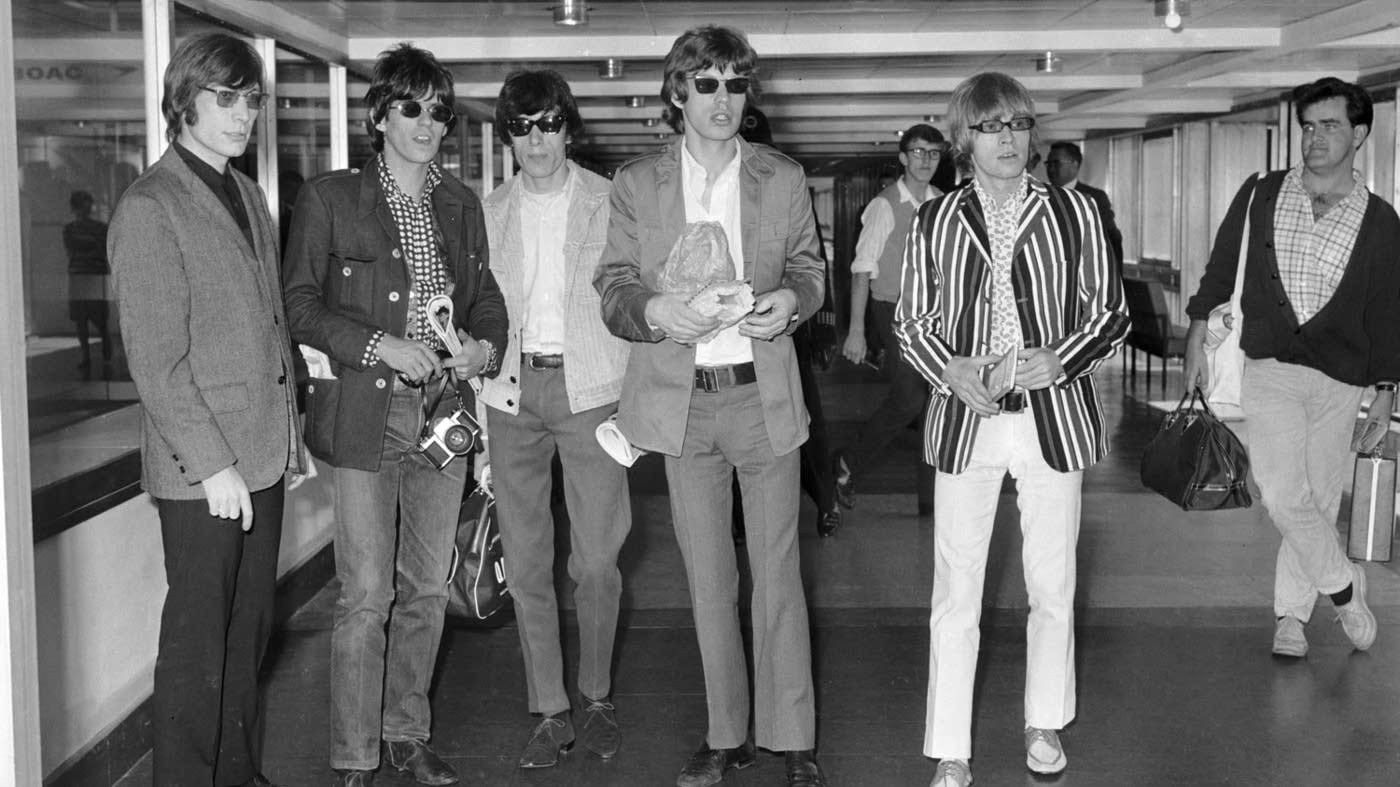
Pictured: The Rolling Stones in 1966 at London Airport, subsequently renamed Heathrow. Form L to R: Charlie Watts (d), Keith Richards (g; v), Bill Wyman (bg), Mick Jagger (v; h), Brian Jones (guitar, sitar, dulcimer, marimba, vibraphone, and koto), and off to the side and slightly behind the rest of the band, Ian Stewart (p; org).
Post-Credit Scene
Wait, six Rolling Stones? Yes, indeed! Ian Stewart was the sixth member of The Rolling Stones.
Nicknamed Stu, Ian was a founding member and appeared at their first official gig at The Marquee Club in London on July 12, 1962. Andrew Loog Oldham, who managed the Stones in those days, determined that the group should only be five, relegating Stu to studio recordings, off-stage performances, and road manager.
Accepting this role, Ian Stewart appeared on all Stones studio and live albums from the group’s founding until his untimely death in 1985, except for three: “Their Satanic Majesty’s Request,” “Beggar’s Banquet,” and “Some Girls.”
As a musician, Stu was highly-regarded by the other band members, with Keith Richards remarking, “He used to play boogie-woogie piano in jazz clubs, apart from his regular job. He blew my head off too, when he started to play. I never heard a white piano player play like that before.”
Stewart played with other artists as a side man, including Led Zeppelin (“Rock and Roll” and “Boogie with Stu”), Howlin’ Wolf, Eric Clapton, Ringo Starr, Klaus Voorman, Steve Windwood, George Thorogood, Ronnie Lane, and solo projects by Bill Wyman and Charlie Watts.