This Day in Music
A black bird, a black day, a black-and-white portrait, and Elvis ails, on this day in music.

Releases
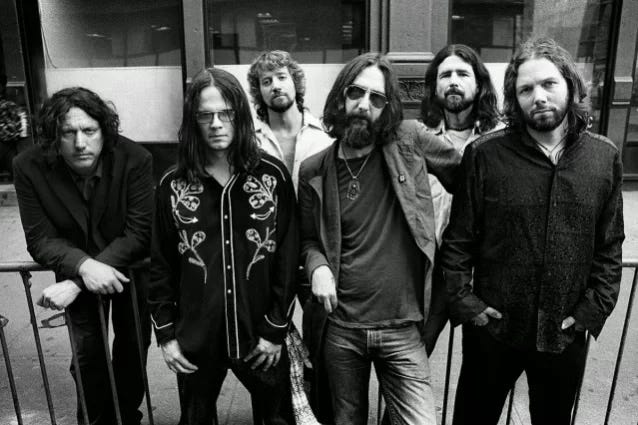
1990: "Shake Your Money Maker," the debut studio album from southern roots rockers, The Black Crowes, is released.
Though the album's title is taken from an Elmore James blues classic that the band had performed live several times, it does not appear on the LP. With a pure rock and roll sound in contrast to the synth-driven 1980's, and the soulful voice of frontman Chris Robinson, the Crowes were an instant success with audiences and critics alike.
All four singles from the album were Top-5 hits on the Billboard Mainstream Rock chart, with "She Talks to Angels" and "Hard to Handle" making it to No. 1. The album itself reached No. 4 on the Billboard 200, No. 4 on the Canada RPM Top Albums chart, and was certified 5x Platinum in the US.
1981: Phil Collins, singer-songwriter and drummer extraordinaire, releases his debut solo studio album, "Face Value." The album had a larger mix of rock than pop, a blend that would slowly flip throughout his career, and remains the best release from his solo catalog.
During an interregnum with his main band, Genesis, Phil began writing personal songs mostly inspired by the divorce from his first wife a year earlier. With co-production from Hugh Padgham, and featuring The Phenix Horns and Eric Clapton among the many players, the album was both critically acclaimed and a huge commercial success.
The lead single from the album, "In the Air Tonight," has become an all-time classic in the rock and pop oeuvre, though it surprisingly did not hit No. 1 in America, peaking at No. 19 on the Billboard Hot 100 and No. 2 on the Billboard Mainstream Rock chart. It did reach the top in several other countries, including Austria, Sweden, and Switzerland.
As for the album, it performed well in the charts, peaking at No. 1 on the UK Albums list and remaining there for seven weeks, No. 1 on the Canada RPM Top Albums chart, and No. 7 on the Billboard 200. In Canada, it is certified Diamond, and in both the UK and the US, it is certified 5x Platinum.
The album's cover features an extreme close-up of Phil in black-and-white, which was updated to an older photo of himself for the 2017 release of the digital remaster.
1976: Speaking of Phil Collins and Genesis, the legendary prog-rockers release their seventh studio album, and first without Peter Gabriel, “A Trick of the Tail.”
Gabriel had decided to leave the band during The Lamb Lies Down on Broadway Tour, informing the group midway though that he would pursue a solo career once the tour finishes. The remaining members decided to carry on as a band, believing there remained sufficient songwriting talent to continue making music. They began the search for a replacement for Gabriel, but after dozens of auditions they could not find the right fit.
The group began the “A Trick of the Tail” project while continuing their recruitment. In the studio, Phil, who had sang background vocals and harmonies since joining Genesis in 1970, sang the song “Squonk” as a placeholder, but the band was so impressed, after a little cajoling, they decided that Phil would be their permanent lead singer.
Concerned about the need for a frontman and not perform solely as a singing drummer, Collins brought in a second drummer to play on Tail’s subsequent tour. That role went to prog-master Bill Bruford, ex- of Yes and King Crimson, for the first leg of the tour, and then to Chester Thompson, ex- of Weather Report and Frank Zappa, who would play live with the band for 31 years, until October 13, 2007, the final date of Turn It On Again: The Tour.
“A Trick of the Tail” received mostly positive reviews and a warm welcome from fans. The Rolling Stone Album Guide rated it 4/5-Stars, and AllMusic ranked it 4.5/5-Stars, with most critics remarking that they were impressed by the ability of Genesis to thrive following the departure of Peter Gabriel. The record had up-and-down performances on the charts, reaching only No. 31 on the Billboard 200, but No. 3 on the UK Albums list, in addition to No. 1 in France, but No. 93 in Australia.
Over time however, the album caught on and did good commercial business, earning Gold certification in the US, the UK, and France, and Platinum in Canada. The band itself would flourish and become huge in the 1980’s, leading Peter Gabriel to remark somewhat humorously that it was humbling to see the band reach superstardom only after he left.
Including the great tracks “Dance On A Volcano,” “Ripples,” “Robbery, Assault, and Battery,” and “Mad Man Moon,” this is a different, yet wonderful record by Genesis. They would follow it up later that year with “Wind and Wuthering,” an introspective record that appeals to a more-limited following of the band, but is also quite good, with both Steve Hackett and Tony Banks commenting that it is among their favourite works by the band. It spun out their first single to chart in the US, “Your Own Special Way.”
1970: On what was Friday the 13th at the time, an eerie sound of doom is heard from the radio speakers in the form of Black Sabbath's eponymous debut studio album.
The band's dark and heavy sound was the result of guitarist Toni Iommi's unique way of tuning and playing his guitar, which he did to overcome a severe finger injury, along with bassist Geezer Butler treating his instrument more like a guitar than a bass. The record was considered the first true heavy metal album, and the first in the doom-metal sub-genre.
Though contemporary critics were not impressed, retrospective reviews were much more fair, and this quality album is now rated 5-stars by The Rolling Stone Record Guide on the high end, and a 7/10 by Uncut on the low end. It peaked at No. 8 on the UK Albums list, and was certified Gold. In the US, it reached No. 23 on the Billboard 200 and was certified Platinum.
With a title track included in the song list, one can listen to “Black Sabbath” by Black Sabbath, from the album “Black Sabbath,” leading to the obvious conclusion that more bands should have included eponymous songs on their eponymous LP’s throughout rock history.
Events
1973: Upon arriving in Singapore, Led Zeppelin was barred from de-planing by immigration agents due to the length of their hair. Long hair was considered by the country's officials to be emblematic of the anti-authoritarian counter-culture that was ruining Western societies. With their concert subsequently cancelled, the band set off for their next destination.
The Friday Frank
1971: An article is published in Melody Maker magazine titled, They Seem to Think Frank’s Obscene. The feature was a story about the last-minute cancellation by management at the Royal Albert Hall of the live performance of “200 Motels” by Frank Zappa and The Mothers of Invention, featuring The Royal Philharmonic Orchestra and its choir, earlier that week.
The Hall cited obscenity of the lyrics when cutting the show, and did so without any prior notice to FZ’s manager, Herb Cohen.
Zappa and Cohen filed a breach-of-contract lawsuit against the Hall, but lost the case, decided at London’s High Court in 1975.
The Daily Elvis
1973: Elvis falls ill while performing in Las Vegas and is treated by Dr. Sidney Bowers, to whom he gifts a white Lincoln Continental as a token of his appreciation.
Pictured: The Black Crowes.