This Day in Music
Happy ∏ Day! It's also Einstein's birthday. Plus, Frippertronics and Elvis wins a Grammy, on this day in science, uh...music.

Releases
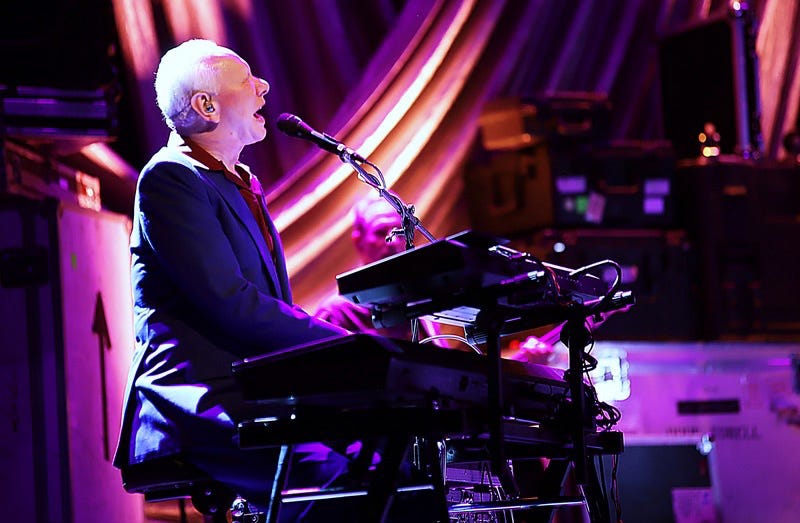
1984: Masterful English singer-songwriter Joe Jackson releases his seventh studio album, “Body and Soul.” A mix of pop, jazz, and latin music styles with dynamic arrangements and smokey-jazz aura, it was described as “sophisti-pop” by some reviewers, a strange, if not apt, description.
The CD release of the record was in October of 1984 and was labeled “DDD,” meaning it was recorded, mixed, and mastered digitally. This meant a much higher-quality CD experience when compared to analog albums transferred to digital.
The LP was graded tepidly by critics, a clearly unfair assessment of the work. AllMusic ranked it 3.5 Stars, while Rolling Stone went as high as 4-Stars. With hit songs “You Can't Get What You Want (Till You Know What You Want)” and “Be My Number Two,” along with great deep cuts like “Cha Cha Loco” and the opening track, “The Verdict,” the album achieved modest commercial success, peaking at No. 20 on the Billboard 200 and at No. 13 on the Canada RPM Albums chart.
It’s a fine album, however, that should get more attention.
1980: Legendary British guitarist, composer, and bandleader Robert Fripp releases his second solo album, the very cool “God Save the Queen / Under Heavy Manners.” The record is a showcase of “Frippertronics,” Robert’s innovative real-time tape-looping technique.
There are five tracks on the LP, divided into two independent programs: the ambient-ish Side A, “God Save the Queen,” and the rhythmic Side B, “Under Heavy Manners,” dubbed “Discotronics” by Fripp for the addition of bass and drums. All of the guitar loops were recorded at live appearances in 1979. “God Save the Queen” (not the British national anthem, but Fripp’s original piece based on the anthem’s opening theme) loops were recorded at NBC-TV’s Midnight Special episode on October 5, 1979. Fripp had been invited to the show specifically to demonstrate Frippertronics.
The other venues of tape-loop recordings included Tower Records in Berkeley, CA for “Red Two Scorer,” The Calgary Planetarium for “Under Heavy Manners,” and Madame Wong’s, the legendary music venue in Los Angeles’s Chinatown, for “The Zero of the Signified.” The remaining tracks and production were done at The Hit Factory in New York.
The title was originally set to be “Music for Sports,” but Fripp decided to change it to avoid confusion with Brian Eno’s “Music for…” records. Additional musicians were Michael “Busta” Jones on bass, Paul Duskin on drums, and David Byrne of Talking Heads, credited as Absalm el Habib, singing lead vocals on “Under Heavy Manners.”
1983: Marillion releases “Script for a Jester's Tear,” the English-neo-prog-band-with-the-Scottish-lead-singer's debut studio album. It's the only album to feature founding member and original drummer, Mick Pointer, who was released following the album's tour due to the band's dissatisfaction with his performance. He was replaced by Ian Mosley, who continues to be Marillion's drummer to this day.
Critics were split on the album, with Record Mirror rating it 4/5-Stars, but Smash Hits grading it only 4/10. Lead singer Fish (Derek William Dick from Edinburgh) remarked in later years that he was not satisfied with his singing, considering it to be somewhat novice and in need of development. Guitarist Steve Rothery had similar criticisms of his own performance: “I didn't have the experience, I didn't know the sound I wanted...Anyway, it wasn't a sound that I was in love with.”
It was nonetheless a solid release that was accepted warmly by audiences. A commercial success, it reached No. 7 on the U.K. Albums Chart and was certified Platinum. Rare for a prog album, it had a Top-40 single in “He Knows You.”
Marillion would score a huge hit in 1985 with their third studio LP, “Misplaced Childhood.” Fish would leave for a solo career after the fourth album, “Clutching at Straws.” He earned a dedicated following and enjoyed a long career, retiring just last year, having performed his final show on March 9, 2025 at the O2 Academy in Glasgow.
1980: Northern soul band Dexys Midnight Runners, from Birmingham, England, release the song “Geno,” the great first single from their debut studio album, “Searching for the Young Soul Rebels.”
A tribute to soul singer Geno Washington, the song combines northern soul with a little punk and a little ska, and went all the way to No. 1 on the U.K. Singles Chart, where it remained for two weeks. It signalled the Dexys were here to stay, and though not particularly prolific in their output, they've never gone away, with their most recent album, “The Feminine Divine,” released in 2023.
Nonetheless, the Dexys only fame in America was the hit song “Come On Eileen,” from their second album, “Too-Rye-Ay,” prompting The Simpsons to drop-in this funny quip from the great Season 5 episode, Homer’s Barbershop Quartet:
Events
1986: The Miami Vice episode Payback airs on NBC-TV and stars musical genius Frank Zappa as drug lord Mario Fuente, purveyor of “weasel dust” (i.e. cocaine).
No stranger to TV, Zappa had previously appeared on The Monkees in 1968 as Michael Nesmith, while Nesmith played Zappa, and on Saturday Night Live in 1976 and 1977, when he was also the musical guest. In similar fashion to Mike Nesmith playing Zappa on The Monkees, Ringo Starr played Zappa in the movie 200 Motels.
Miami Vice would be the first role that required proper acting rather than “parody-of-themselves” comedy characters. Though Frank never watched the show, his son Dweezil was a huge fan and encouraged FZ to take the guest-starring role, as so many other pop and rock stars did for the show, including Phil Collins, Don Henley, Ted Nugent, Leonard Cohen, James Brown, and even jazz legend Miles Davis.
Though Zappa wasn't exactly a scene-stealer, as seen in this clip, he contributed the term “weasel dust” to the show’s script, a term very much in-line with his vernacular and anti-drugs position.
The Daily Elvis
1972: At the 14th annual Grammy Awards, held at the Felt Forum in New York City, Elvis Presley is awarded the Lifetime Achievement Award, at the time named The Bing Crosby Award. Elvis’s recording career had only been 18 years long at that point, but in the days before The Rolling Stones and Bob Dylan reached 60 years of recording, 18 was a long time. He would not receive the award until August 28th, while at a performance in Las Vegas.
Pictured: Joe Jackson performing in 2022.