This Day in Music
Michael Fitzgibbon
With so many albums and so little time, focus is on the meat, and Elvis is No. 1 again, on this day in music.
Uncle Meat
1969: American composer and multi-instrumentalist-but-mostly-guitarist Frank Zappa releases his seventh official album, the legendary double-LP “Uncle Meat.” It is the sixth album by The Mothers of Invention.
Recorded mostly at Apostolic studios in New York, the record also used several live recordings taken from different concerts at Royal Albert Hall in London, Whiskey-A-Go-Go in West Hollywood, Falkoner Theatre in Copenhagen, and Stadio Renzo Barbera in Palermo, Sicily.
The album was originally conceived as part of an overarching series of albums titled No Commercial Potential, which Zappa had to abandon because his record company, Verve Records, did not accept the concept. It was a common battle between FZ and Verve, with the latter failing to understand Frank’s experimental nature. Zappa would move to Frank Sinatra’s Reprise Records for his next project, “Hot Rats,” while still issuing output on the Bizarre Records label formed by Zappa and his business partner, Herb Cohen.
Though No Commercial Potential was shelved, three other albums tied by the similar tongue-in-cheek theme of music with no appeal to the masses were created from the concept. The first two were “We’re Only in It for the Money” by The Mothers of Invention, released in March of 1968, and “Lumpy Gravy” released in May of 1968 by Frank Zappa & the Abnuceals Emuukha Electric Symphony Orchestra (a group of Hollywood session musicians organized by FZ).
The third release arrived in December of 1968, titled “Cruising with Ruben & The Jets,” by Ruben & The Jets (a pseudonym of The Mothers of Invention), which included a Cal Schenkel cover illustration of Zappa as an anthropomorphic dog with a speech bubble that sarcastically asks, “Is this the Mothers of Invention recording under a different name in a last ditch attempt to get their cruddy music on the radio?”
“Uncle Meat” was the fourth and final record emerging from No Commercial Potential, and also the soundtrack to the movie of the same name. Though the movie is not particularly good, the album is quite an achievement. All four records are tied by what Zappa terms “conceptual continuity,” a reference he used for re-using and re-contextualizing his ideas, or creating new material as a variation of something from the past.
Reflecting the melange of styles typical for the Mothers, like jazz, orchestral, and blues, the record was praised as much for its composition and performance, as for its innovative recording techniques.
Apostolic studios had a 12-track machine built by Scully Recording Instruments that was cutting-edge technology at the time. It enabled a smoother method of recording overdubs, a Zappa specialty, for which he took great advantage, choosing to splice-in a wide variety of percussion, keyboard, and wind instruments, studio effects, live recordings, and spoken-word moments to tell his story.
It was a critical success, earning high praise from most music writers. As part of its 4.5-Star review, AllMusic wrote “…despite the absence of a conceptual framework, the unfocused sprawl of Uncle Meat is actually a big part of its appeal. It’s exciting to hear one of the most creatively fertile minds in rock pushing restlessly into new territory, even if he isn’t always quite sure where he’s going.” The Rolling Stone Album Guide and the Encyclopedia of Popular Music both rated “Uncle Meat” 5-Stars. The album does of course have a conceptual framework, and the fact AllMusic missed it perfectly reflects said concept.
Lowell George and Buzz Gardner, younger brother to band member Bunk Gardner, are credited on the album as members of the band, but did not participate in the recording sessions. It’s unknown if they were part of the live performances that were incorporated into the final production. Lowell George and Roy Estrada would leave the Mothers later in 1969 to form the band Little Feat. Billy Mundi left the band during production to join the band Rhinoceros.
Also appearing on the album, but without credit, was Pamela Zarubica as the character Suzy Creamcheese. Zarubica was a long-time friend of Zappa and played the role of Suzy Creamcheese on a number of occasions. She was his roommate in 1966 in Laurel Canyon and introduced FZ to his future wife, Gail Sloatman. She’s listed as an influence on Zappa’s music in the liner notes to “Freak Out,” and she was prone to using the phrase “wowie zowie,” which Frank turned in to a song.
Introducing the Zappa/Mothers classics “King Kong,” “Dog Breath Variations,” “Pound for a Brown,” “Mr. Green Genes,” and “Cruising for Burgers,” which Zappa would perform throughout the remainder of his career, “Uncle Meat” was a popular album amongst audiences, reaching No. 43 on the Billboard 200, a rare height for avant-garde music.
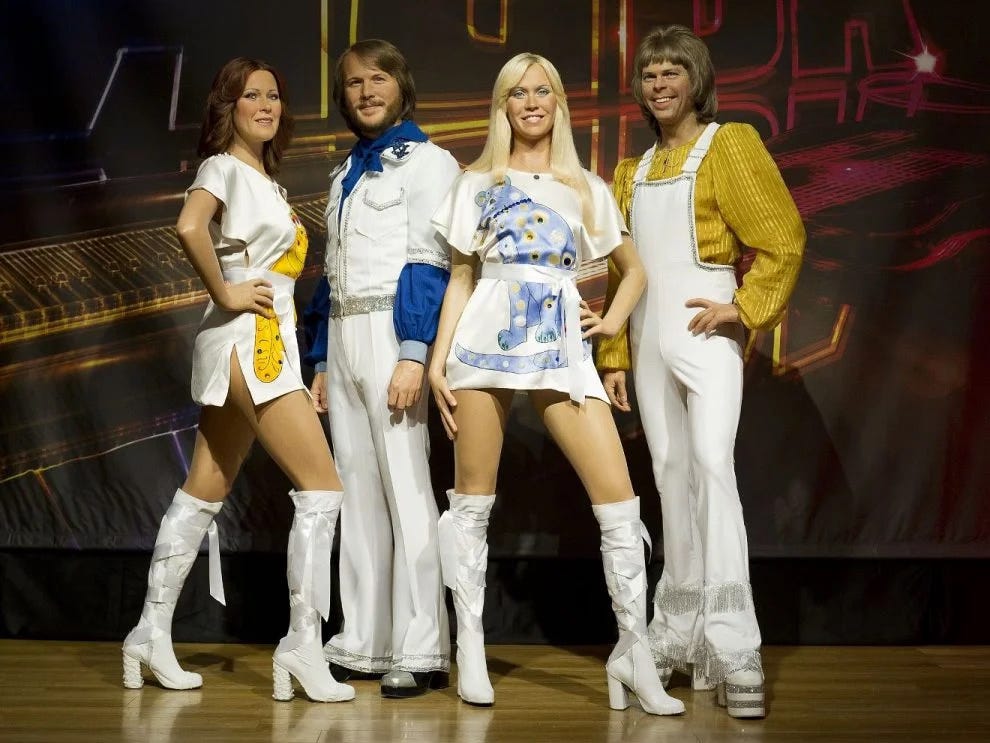
ABBA
1975: The “Sweetums from Sweden” (I made that up!), ABBA, release their second studio album, simply titled “ABBA.” Coming off the heels of the awesome Eurovision-winning track and album, “Waterloo,” this record catapulted ABBA to global stardom.
Well-reviewed by critics, the record spun-out seven singles, including the No. 1 “I Do, I Do, I Do,” the No. 1 “S.O.S.,” and the No. 1 “Mamma Mia.”
The album itself has sold over four million copies worldwide. It is unsurprisingly certified Gold in the U.K., Denmark, Finland, and Hong Kong, and of course went quadruple Platinum in Sweden.
Light Fuse, Get Away
1998: “Light Fuse, Get Away,” the first live album by the Georgia jam-rock band Widespread Panic, is released. Recorded at various shows on their 1997 tour, the double-CD is 2.5 hours of extended jamming, with most songs running eight to eleven minutes in length. Highlights include the band's original standard “Porch Song” and J.J. Cale's “Travelin' Light.”
Never Let Me Down
1987: English singer-songwriter and musician David Bowie releases his 17th studio album, “Never Let Me Down.” Released as a comeback to his 1984 critical disappointment, “Tonight,” Bowie described the record as a return to straight ahead Rock and Roll.
The record was a Top-10 hit in Europe and Canada, but did not succeed in the U.S., and was once-again poorly rated by critics. Highlight tracks include “Day In, Day Out,” “Time Will Crawl,” and “Never Let Me Down.” It was certified Platinum in Canada and Gold in the U.S.
Empty Glass
1980: Pete Townshend releases his second studio solo album, the fabulous “Empty Glass.” Addressing themes of alcoholism, drug addiction, mental illness, and lost friends, particularly Keith Moon, the record is a collection of ten personal songs by Townshend.
During the writing of “Empty Glass,” activity with The Who began to pick-up again, leaving Townshend to write songs both for his solo work and for a new Who album, which became the mediocre “Face Dances” in 1981. Roger Daltry at the time said that he felt let down by Pete as he believed some of the songs on “Empty Glass” should have been recorded by The Who for “Face Dances,” making it a better album.
With high marks from critics, “Empty Glass” was also a commercial success, reaching No. 5 on the Billboard 200, No. 2 on Canada’s RPM Top Albums list, and No. 1 on the U.S. Album-Oriented Rock chart. Billboard wrote of the LP, “…impressive album that showcases perhaps above all, Townshend's incredible versatility on guitar with each riveting riff rising to the forefront.” It carries a 4.5-Star rating at AllMusic.
All of the songs are wonderful, but the highlights are “Gonna Get Ya,” “I Am an Animal,” and the four singles, “Rough Boys,” “Let My Love Open the Door,” “A Little is Enough,” and “Keep on Working.”
With Townshend covering guitars, piano, synthesizers, and vocals, additional musicians included four drummers. The legendary Simon Phillips plays drums on most tracks, with Kenny Jones playing “Rough Boys,” future Big Country drummer Mark Brzezicki performing “Gonna Get Ya,” and James Asher on two tracks, “Jools and Jim” and “Keep on Working.” Tony Butler played bass and John Bundrick added additional keyboards, with both musicians also singing background vocals. Peter Hope-Evans played harmonica on “Cat’s in the Cupboard.”
The record was certified Platinum in the U.S. and Canada, and Silver in the U.K. It’s my favourite solo album by Pete Townshend.
The Daily Elvis
1962: The Wally Gold/Aaron Schroeder song, “Good Luck Charm,” as performed by Elvis, reaches No. 1 on the Billboard Hot 100. It's the 21st time Elvis had the No. 1 song on a chart, though not always on the Billboard Hot 100. It would remain in the top spot for two weeks.