This Day in Music
Michael Fitzgibbon
The blog gets stoned and Elvis gets fired, on this day in music.
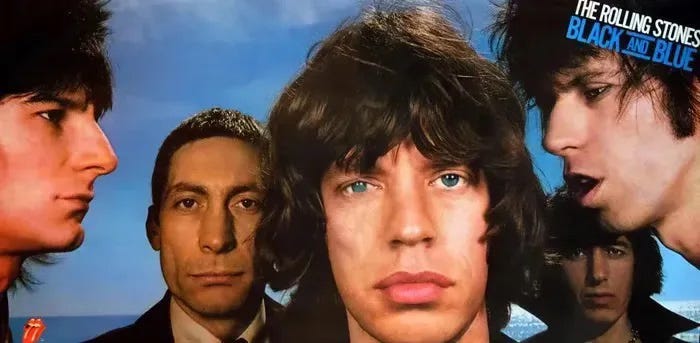
Black and Blue
1976: Legendary British rockers The Rolling Stones release their 15th studio album, “Black and Blue.”
With the recent departure of lead guitarist Mick Taylor, the sessions doubled as auditions for his replacement, including Wayne Perkins, who plays the solo on the tracks “Hand of Fate” and “Worried About You,” the latter not appearing on a Stones album until 1981's “Tattoo You.” Also appearing is Ronnie Wood of The Small Faces, who previously recorded with the band on the track “It's Only Rock and Roll (But I Like It),” and earned the job in time to put his face on the album cover. He's been with the Stones ever since, becoming a full partner in 1990.
Stylistically, the record is typical Stones bluesy-rock, but with influences from reggae and funk. Well-received by critics and fans, it was the fifth consecutive No. 1 album for the band, on a run of nine, and was certified Platinum. It’s a quietly excellent album by the group.
As they were wont to do, the Stones stirred up controversy with a salacious billboard on Sunset Blvd. in Los Angeles. Model Anita Russell was styled in themes of bondage and sadomasochism, bound with rope and quoted as saying, “I’m Black and Blue from The Rolling Stones—and I love it!.” Several of the perpetually-aggrieved groups of the era were moved to righteous indignation and protest. The advert certainly took the English term “cheeky” to a whole new level.
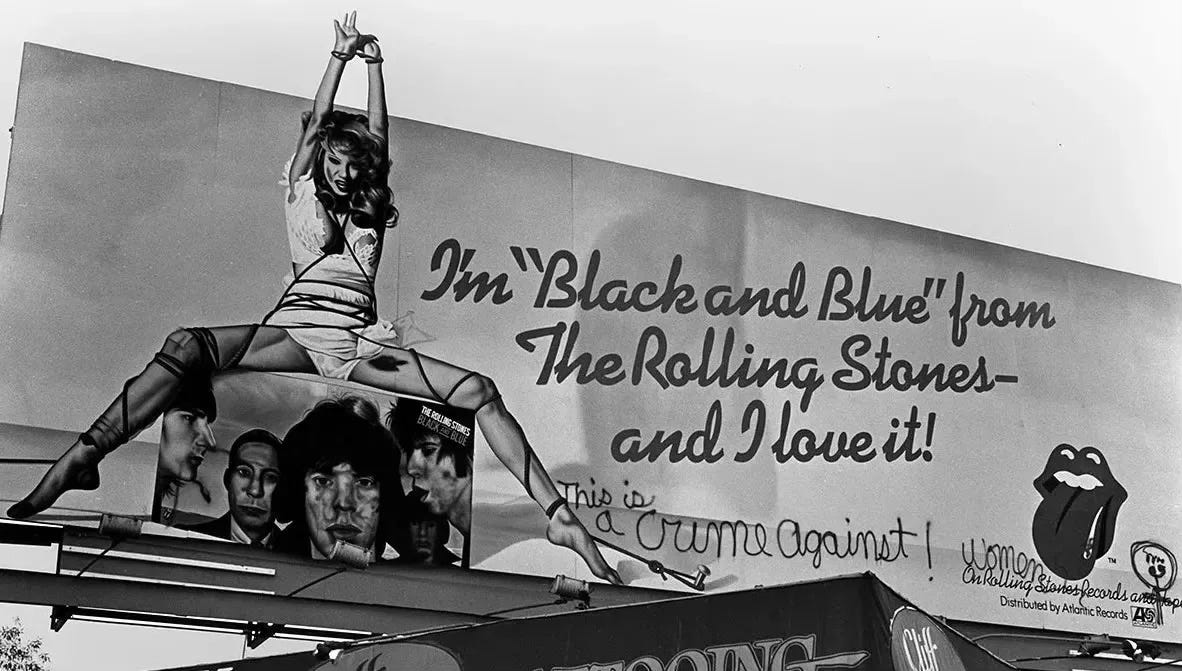
The controversial Stones billboard on Sunset Blvd., including graffiti explaining that, “This is a crime against women!”
Sticky Fingers
1971: Legendary British rockers The Rolling Stones release their eleventh studio album, “Sticky Fingers.” The second album to include Mick Taylor on all tracks, the record is renowned for its interactive cover on which an actual zipper can be pulled down on a man wearing jeans. (How many record collectors out there have zipper-shaped indentations on the back cover of “Exile Main Street” from living beside “Sticky Fingers” for so long?)
Cited by many Stones fans as their favourite from the band, “Sticky Fingers” appealed to a broad audience, making it the No. 1 record in eleven countries, including the U.K., U.S., Canada, Australia, Japan, and across Europe.
The album begins with the pop-oriented classic, “Brown Sugar,” it’s weakest moment really, then instantly changes style to darker, dirtier, roots rock that featured a second classic, “Wild Horses,” and the great deep cuts, “Sister Morphine,” “Dead Flowers,” “Moonlight Mile,” and the extended-length, “Can't You Hear Me Knocking,” which at 7:14 is the fourth-longest Stones song.
Universally acclaimed by critics, the LP scores 100/100 on MetaCritic, and was the second of nine consecutive No. 1 albums in the U.K./U.S. for the group.
Living in a Ghost Town
2020: Legendary British rockers The Rolling Stones (this seems repetitious) release their 117th single (what?!), “Living in a Ghost Town.” With basic tracks recorded before the onset of the COVID-19 pandemic, the band realized that it was the perfect pandemic song, and made use of modern technology to finish recording the single at individual locations while in lockdown.
A video hit single, it features many scenes of well-known urban centres shot with a fisheye lens, relaying a feeling of claustrophobia. Hitting on the global nature of the event, the video includes cities from across the world: Los Angeles, London, Oslo, Cape Town, Margate (Kent, England, from whence the Stones hail), Osaka, and my adopted hometown, Toronto.
With a Little Help from My Friends
1969: Joe Cocker releases his first studio album, “With a Little Help from My Friends.” An album almost entirely of covers, it features The Beatles' “With A Little Help from My Friends,” and the definitive version of Traffic's “Feeling Alright,” one of the few examples of a cover that is better than the original (at least in my opinion.)
Ordinary Average Guy
1991: The ninth studio album from Joe Walsh is released. Titled “Ordinary Average Guy,” it scored a minor hit with the title track.
Voulez-Vous
1979: ABBA releases their sixth studio album, “Voulez-Vous.” A huge hit in Europe, it was their fourth record to reach No. 1 outside of Scandinavia, and scored five Top-10 hit singles in the U.K.: “Chiquitita,” “Does Your Mother Know,” “I Have a Dream,” “Voulez-Vous,” and “Angeleyes.” The album itself was No. 1 across Scandinavia, Europe, and Australasia, and would become the second-highest selling album of their career.
Ramones
1976: American punk rockers Ramones burst onto the scene with their debut studio album, “Ramones.”
Lest anyone think the Brits invented punk, Ramones were first, releasing the single “Blitzkrieg Bop” seven months before Sex Pistols' “Anarchy in the U.K.,” though the Pistols had far more punk attitude. English punks The Damned also beat Sex Pistols to market by a month.
Inspired by the glam-rock movement of the early seventies, “Ramones” introduced an entire new sub-genre to America, earned the band legions of fans, and was certified Gold.
The Daily Elvis
1956: Appearing at The New Frontier Hotel for his debut performance in Las Vegas, Elvis begins a two-week run opening for the Freddie Martin Orchestra. Accompanied by Bill Black on bass and Scotty Moore on electric guitar, the trio failed to impress hotel management, who terminated the contract after the first week.
Elvis would not play again in Las Vegas for thirteen years, partly due to the lingering effects of the failed first run, but mostly due to his focus on movies instead of concerts throughout the sixties.