This Day in Music
Michael Fitzgibbon
Into every town a little darkness, a little magic, some scratching, and Elvis makes a fantastic record, on this day in music.
Peter Gabriel
1978: Legendary British singer-songwriter and musician Peter Gabriel releases his second studio solo album, “Peter Gabriel.” The record is often nicknamed Scratch for its cover design, and to distinguish it from Gabriel’s three other eponymous studio albums.
Producing the record was Robert Fripp of King Crimson, who also played in Gabriel’s touring band for his debut solo tour. Fripp employed his tape-looping technique Frippertronics on the song “Exposure,” which he co-wrote with Peter.
Gabriel chose Fripp to produce because he was seeking a spontaneous work process, and credited Fripp with establishing a studio environment conducive to creativity.
Preferring a raw production, they would limit the number of attempts at perfecting an idea to three, and move on if they felt they couldn’t quite get it. Another of Fripp’s techniques was to pitch-shift Gabriel’s vocals, creating a slightly off-key sound, and to limit reverb, making the album sound “dry.” Fripp’s concept of “silent reverb” was an attempt at keeping reverb barely noticeable to the listener.
Musicians appearing on the album included Tony Levin on bass and Chapman Stick. Levin would join Fripp on his next solo album, “Exposure,” and then become part of the newly-established King Crimson lineup in 1980, playing on all subsequent KC records, except the final two studio albums. Roy Bittan of Springsteen’s E. Street Band played keyboards, and Sid McGinnis, who would play for David Letterman’s CBS Orchestra, and credited with many studio sessions, played guitar on several tracks, along with steel guitar, and mandolin.
The LP was modestly praised by critics. Rolling Stone rated it 3-Stars, Q gave it 4-Stars, The Village Voice graded it a B-, and it earned a 4-Star ranking from Encyclopedia of Popular Music. Reviewers found the album to be more esoteric than its predecessor, venturing into self-indulgence. Basically all of the usual pretentious criticisms of any work that isn’t mainstream rock. In reality, the album is far better than its ratings and I quite like it myself.
All of the tracks have a certain charm that grows on the listener, but only two found meaningful radio play, including the one official single, “D.I.Y.,” and “On the Air,” both of which would feature in Gabriel’s live sets for decades to come. The song “Exposure” also had some FM radio exposure (get it?), and was re-recorded with the exception of Gabriel’s vocals by Fripp for his next solo album, also titled “Exposure.”
“Peter Gabriel” peaked at No. 45 on the Billboard 200 and did not earn any sales certifications.
Darkness of the Edge of Town
1978: “Darkness on the Edge of Town,” the fourth studio album by Bruce Springsteen is released. Though once again credited solely to Springsteen, the E. Street Band plays all of the backing parts, as they did for Bruce’s prior album, “Born to Run,” though the lineup of the band changed between those releases.
Following a series of legal disputes with former manager Mike Appel, creating a three year delay since the release of “Born to Run,” Springsteen and the E. Street Band finally entered The Record Plant in New York to begin recording the new album. Jon Landau once again co-produced with The Boss.
A number of classic Springsteen songs appear on the LP, including the first single, “Prove it All Night,” the second single, “Badlands,” the third single, “The Promised Land,” “Candy’s Room,” and the title track, “Darkness on the Edge of Town.” The songs “Adam Raised a Cane” and “Racing in the Streets” were also popular.
Contemporary reviews were mostly positive, with some detractors. The Rolling Stone Record Guide rated the album 5-Stars in 1979, but then dropped it to 4-Stars in its 2nd edition in 1983, elevating the record back to 5-Stars for its 4th edition in 2004. The harshest rating was from The Philadelphia Inquirer, which gave it only 1-Star (out of four). The Village Voice graded it B+ and Record Mirror ranked it 5-Stars. Retrospective reviews are nearly unanimous that it was a 5-Star album.
Unsurprisingly for a Springsteen record, it did well in the charts, peaking at No. 5 on the Billboard LP & Tapes chart, No. 7 on the Canadian RPM 100, and No. 4 in Netherlands. In the U.S., it is certified 3x Platinum, and is also Platinum in Canada and Australia. It was certified Gold in the U.K. and Netherlands.
A Kind of Magic
1986: Queen releases their twelfth studio album, “A Kind of Magic.” It is based on the soundtrack to the movie Highlander, for which Queen contributed several songs, but has no soundtrack album of its own.
The first LP released following Queen’s acclaimed performance at Live Aid the year before, it was a critical disappointment but commercial success. In his Queen biography, Mark Blake wrote, “Like every Queen record since “Jazz,” “A Kind of Magic” was a so-so album, cleverly loaded with two or three potential hit singles.” It was rated only 2-Stars by The Rolling Stone Album Guide.
Audiences disagreed with the critics, sending the album to double-Platinum certification in the U.K. and Gold in the U.S. It performed even better in continental Europe, where it was triple-Platinum in Poland, double-Platinum in Switzerland, and Platinum in Spain, Austria, and Germany.
On the charts, “A Kind of Magic” reached No. 1 in the U.K., but only No. 46 on the Billboard 200 in the U.S. It was also No. 1 in Argentina and a Top-10 in several markets, including Austria, Netherlands, France, Germany, Switzerland, and Norway.
The Daily Elvis
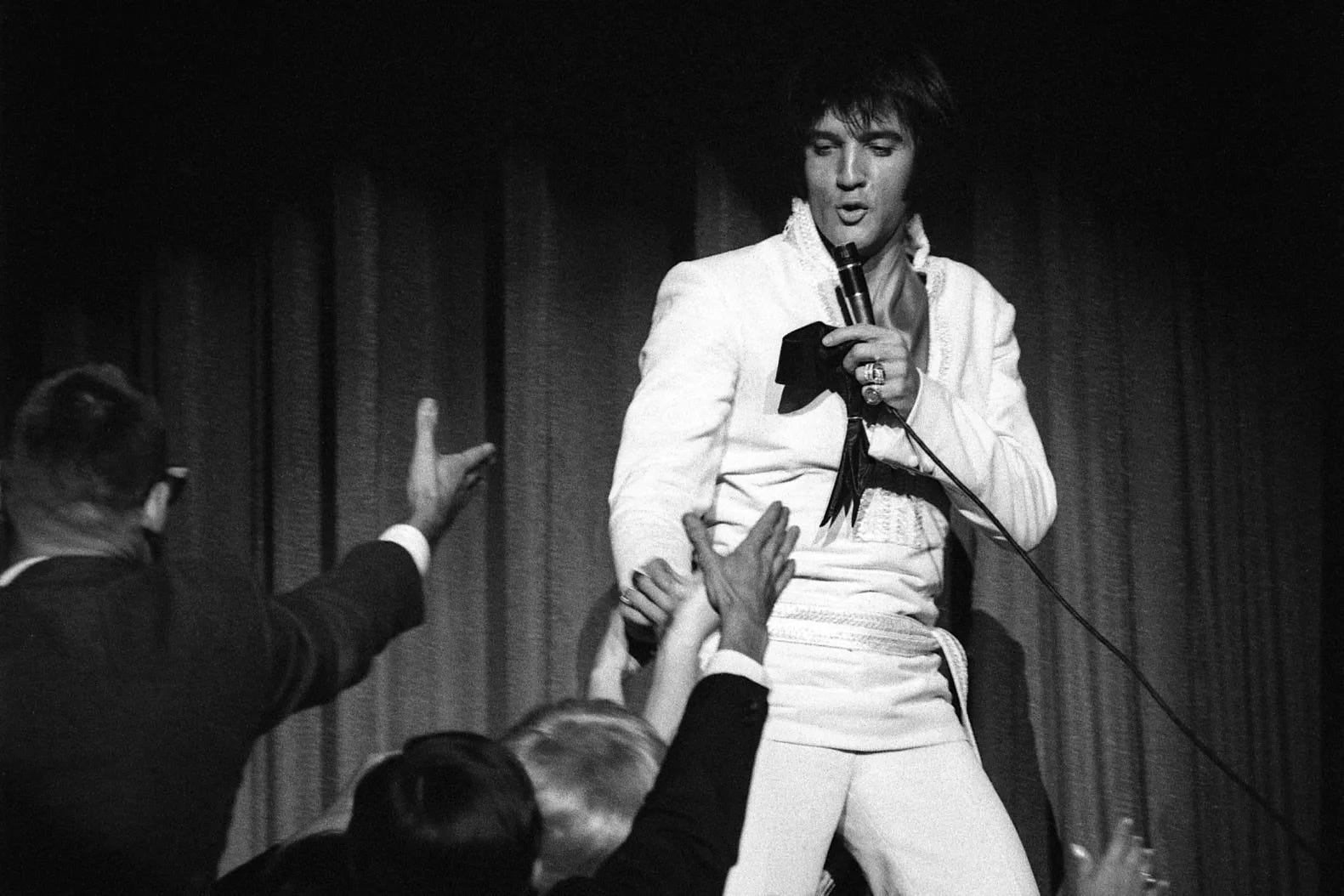
1969: The King of Rock and Roll Elvis Presley releases his tenth studio album, “From Elvis in Memphis.” It was Presley’s first non-soundtrack album in two years, and the first since his wildly successful comeback special in 1968. The LP cover is a still photo from that special.
Some of the classic songs appearing on the record include the No. 1 Mac Davis-penned single, “In the Ghetto,” Hank Snow’s “I’m Moving On,” and “Long Black Limousine” by George-Stovall.
The record was universally acclaimed by critics, earning 5-Stars at SputnikMusic, 5-Stars at AllMusic, and 5-Stars from The Rolling Stone Album Guide. It peaked at No. 1 in the U.K., No. 13 on the Billboard 200, and No. 10 in Canada. It was certified Gold in the U.S.