This Day in Music
Michael Fitzgibbon
Once again over-using the term legend, but it’s once again well-deserved, and Elvis rocks them outside of Tahoe, on this day in music.
American Stars and Bars
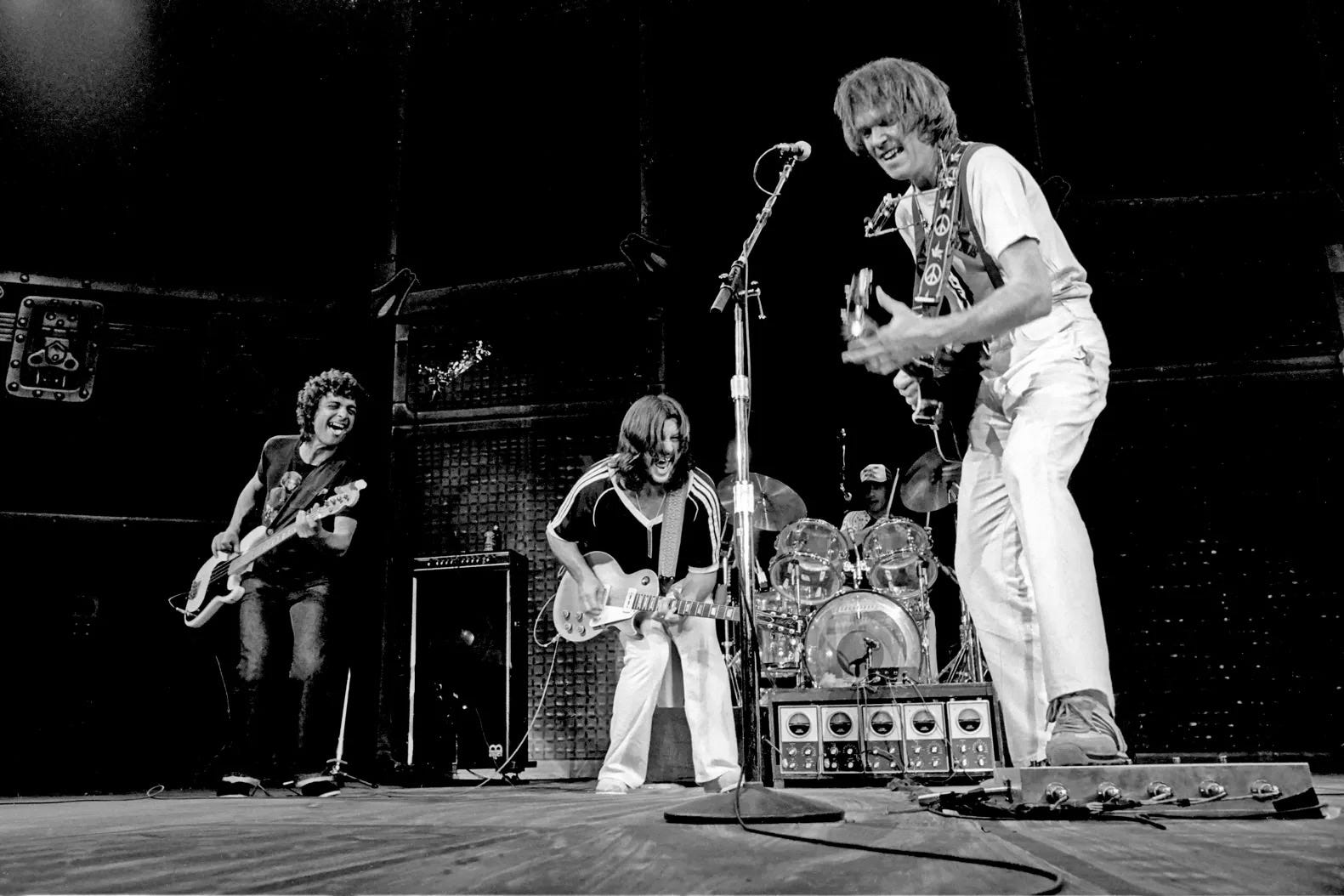
1977: Legendary Canadian singer-songwriter Neil Young releases his eighth studio album, “American Stars and Bars.” It’s the third of Neil’s albums with long-time collaborators, American band Crazy Horse.
Favourably rated by critics, the album was a modest commercial success, going to No. 16 in Canada and No. 21 in the U.S. A Gold-certified record, it features one of Neil’s most popular songs, the 8-minute+, guitar-driven, “Like a Hurricane.”
I like this album, though it’s not one of my absolute favourites by Neil.
Unrest
1974: “Unrest,” the second studio album from English experimental prog band Henry Cow is released. Following the departure of saxophonist Geoff Leigh, the band brought in Lindsay Cooper, playing oboe and bassoon, giving them a distinctive new sound.
Members of England’s “Canterbury Scene” arts community, which centred around the home of “Lady June” Cramer in Westminster’s wealthy enclave of Maida Vale, the band was founded by University of Cambridge mates Fred Firth and Tim Hodgkinson. Maida Vale was previously famous as the location of Mr. and Mrs. Tony Wendice’s flat in the great Alfred Hitchcock movie, Dial M for Murder.
Many other famous musicians were part of the scene, including Hugh Hopper and Kevin Ayers of Soft Machine, Dave Stewart of National Health and Bruford, Mike Ratledge of Soft Machine and solo/collaborative works including with Pink Floyd founder Syd Barrett, Daevid Allen of Gong and Soft Machine, and Richard Sinclair of The Wild Flowers and Caravan.
The incredible drummer, composer, and vocalist for Soft Machine, Matching Mole, and many solo works, Robert Wyatt, was also an influential member of the scene. The album was dedicated to Wyatt following an accident that left him paralyzed when he fell out of a second-story window at Lady June’s house on June 1, 1973.
Though the LP was not a wide commercial success, it and the band enjoyed a loyal following and critical acclaim. “Unrest” was rated 5-stars by AllMusic, A- by Robert Christgau, and 9/10 by Spin magazine. Fellow English prog-rocker and honorary member of the Canterbury Scene, Mike Oldfield, assisted with production as recording engineer on the 12-minute epic track, “Ruins.”
This is an excellent album. Check it out.
Crises
1983: Speaking of Mike Oldfield, he released his eighth studio album on this day, titled “Crises.” The follow-up to his 1982 critical and commercial success, “Five Miles Out,” the LP continued his move toward more accessible song structures, with Side A featuring the 20-minute piece, “Crises,” but Side B dedicated to five shorter songs. It’s a similar pattern that he followed on “Five Miles Out,” though that record also included one 13-minute track on Side B.
As usual, Mike plays the majority of the stringed and keyboard instruments, with additional musicians brought in for vocals and other instruments, including drummer extraordinaire and co-producer Simon Phillips, Jon Anderson of Yes on vocals, and Pierre Moerlen of Gong on mallet percussion.
I’d rate this as one of my favourites from Mike Oldfield, but as with many of my favourite artists’ works, I’m not sure where I’d rank it, though behind “Ommadawn” and “Tubular Bells” for sure.
The Freewheelin’ Bob Dylan
1963: Legendary American singer-songwriter Bob Dylan releases his second studio album, “The Freewheelin’ Bob Dylan.”
The LP features many classics, including “Blowin’ in the Wind,” “Masters of War,” “A Hard Rain’s a-Gonna Fall,” “Don’t Think Twice It’s Alright” (one of my all-time favourites), “Bob Dylan’s Dream,” “Girl from the North County,” which he would re-record with Johnny Cash on the album “Nashville Skyline,” and “Bob Dylan’s Blues.”
Unlike his debut, on which only two songs were his own compositions, all but one track is composed by Dylan, with lyrics reflecting the contemporary issues of the civil rights movement and the fear of nuclear war.
No. 97 on Rolling Stone’s 500 Greatest Albums of All Time (c) 2002, the LP was both a critical and commercial success. Reviewers all assigned it their highest ratings, and though it only reached No. 22 in the U.S., it was a No. 1 record in the U.K., and was ultimately certified Platinum in America.
A pure folk album, all songs are performed by Dylan with guitar and harmonica, except for the one song not penned by Dylan, the traditional blues ballad, “Corinna, Corinna,” which includes a full acoustic band.
This record is definitely one of my ten favourites by Bob Dylan, and appears on my recent unranked list.
Remembering Gregg Allman
2017: Legendary American blues singer-songwriter and organist, and one of my all time favourite blues-rock performers, Gregg Allman, dies at his home in Richmond Hill, Georgia, from liver cancer. He was 69 years old.
With one of the most distinctive voices in contemporary music, nobody could sing blues-rock like Allman. He lived a vibrant and often turbulent life, losing his brother Duane to a motorcycle accident at only 24 years old in 1971 just when his band, The Allman Brothers Band, had achieved massive success with their third official release, the seminal live record, “At Fillmore East.”
He struggled with alcohol, with periods of sobriety, until the mid-1990’s when he kicked it for good, though unfortunately he had damaged his liver considerably, which ultimately led to transplant surgery in June of 2010.
One of his seven wives was none other than American mega-star Cher, from 1975 to 1978. He had five children, three of whom are professional musicians today: Devon Allman, Elijah-Blue Allman (Cher’s son), and Layla Allman.
As a solo artist and frontman for both The Gregg Allman Band and The Allman Brothers Band, Gregg released 29 official albums throughout his career, including his posthumously-released final album, “Southern Blood,” a 5-Star record and highly recommended listening. He also released several retrospective live packages. Three of his records earned Platinum certification, and five went Gold, in total selling nearly 10 million LP’s.
Whether solo, with his band, or with the ABB, Gregg was one of the best live performers in contemporary rock and toured nearly every year.
The Daily Elvis
1974: Elvis is in the midst of a residency at the Sahara Tahoe hotel and casino in Stateline, NV, and performs a highly-regarded set.