This Day in Music
January 30th

Questions, questions, questions, flooding into the mind of the concerned blog-reader…ah, but it’s a great time to be alive, ladies and gentlemen, and that’s the theme for our column today: articles with tangential connections to Frank Zappa, plus the Friday Frank, and a little Elvis on the side, on this paraphrased-Zappa day in music.
People
1951: English singer, songwriter, keyboard player, and drummer-extraordinaire, Philip David Charles Collins, is born in the London borough of Wandsworth. With a string of No. 1 hits and classic performances, his legendary biography is too extensive to fairly summarize in this column. Though he has had to retire from playing due to physical ailments, Phil is first and foremost a drummer.
Most casual listeners know and love his iconic drum intros to his solo hit “In the Air Tonight,” and the song “Mama” by Genesis, but might not know the “statistical density” of Phil’s talent, placing him as one of the premier drummers in the history of Rock and Roll. An appreciation of his skills can be had by listening to the Genesis track, “The Cinema Show,” featuring his impeccable 7/8 groove that changes and increases in intensity to support each chapter of the suite’s extended instrumental third section. Better yet, listen to the live version from the Genesis album, “Seconds Out,” in which he and touring drummer Bill Bruford, ex- of Yes and King Crimson, go absolutely berserk exchanging slurred polyrhythmic figures in perfect 7/8 time underneath of Tony Banks’s keyboard solos and melodies, which are in 4/4 time!
Other examples of Phil’s greatness are found on the Genesis songs “Watcher of the Skies” (speed and independence), “The Musical Box” (dynamics and colouring), “Supper’s Ready” (master of improvisations over odd time signatures), “Firth of Fifth” (powerful double-stroke rolls), and “In the Cage” (jazz-style accenting), or his live duets with long-time touring drummer Chester Thompson, ex- of Weather Report and Frank Zappa, and his work with fusion band, Brand X.
Phil and Chester took the Zappa-written drum fill from the Mothers of Invention song “More Trouble Every Day” and played it live in-sync on the outro of the song “Afterglow.” The best version appears on “Seconds Out,” though the “Three Sides Live” version is the better for all of the fills in the outro taken as a whole.
Phil’s drumming was dynamic. He would play snare drum swishes light as air, followed by rim-shot flams on the toms that sounded like gunshots. As Peter Gabriel remarked, ‘Phil is a phenomenal musician.’
Happy 75th Birthday to Phil Collins!
Releases
1968: Avant-garde New York rockers The Velvet Underground release their second studio album, “White Light/White Heat.” It would be the last album to include founding member and multi-instrumentalist, John Cale.
For this record, Lou Reed dismissed Andy Warhol as the band’s producer and brought in Tom Wilson, who had previously worked with the VU’s Los Angeles rivals, The Mothers of Invention, who, like the VU, were signed to Verve Records. Though the relationship between the two bands was often complicated, Zappa remarked that the VU was one of the few authentic acts of their time, and Lou Reed made the induction speech for Frank Zappa’s entrance into the Rock and Roll Hall of Fame in 1995.
With lyrics that explored themes of drug use, sex, and drag queens, pushing the edges of societal norms of the time, the music of “White Light/White Heat” also crossed boundaries, much of it influenced by free jazz artist Ornette Coleman.
In the studio, the band tried to capture the improvisations, loudness and “on-stage atrocities” of their live performances, resulting in a sound that was compressed and distorted. Though the band members were not happy with the finished product, that distortion worked to complement the music and lyrics, particularly on the 17-minute epic, “Sister Ray,” the final song and standout feature of the album.
Critics at the time were less excited about “White Light/White Heat” than the debut album, but retrospectively it has earned great respect and admiration, as it should, with most reviewers now assigning it their highest ratings.
An esoteric cult classic, it only reached No. 199 on the Billboard 200, but it is a landmark work and recognized as one of the great recordings in Rock and Roll, earning position No. 272 on Rolling Stone Magazine’s list of the 500 Greatest Albums of All Time.
The Friday Frank
2014: The Zappa Family Trust releases the posthumous album “Joe’s Camouflage,” which is recordings of Frank Zappa and his band made during rehearsals for the world tour beginning on September 27th, 1975 in California. The group was a pared-down version of the “Bongo Fury” ensemble, being seven pieces instead of ten.
The Daily Elvis
1964: Elvis purchases the former yacht of President Franklin D. Roosevelt, named the Potomac, for $55,000 ($562,000 in today's dollars). He would ultimately donate the craft to St. Jude’s Children’s Research Hospital in Memphis.
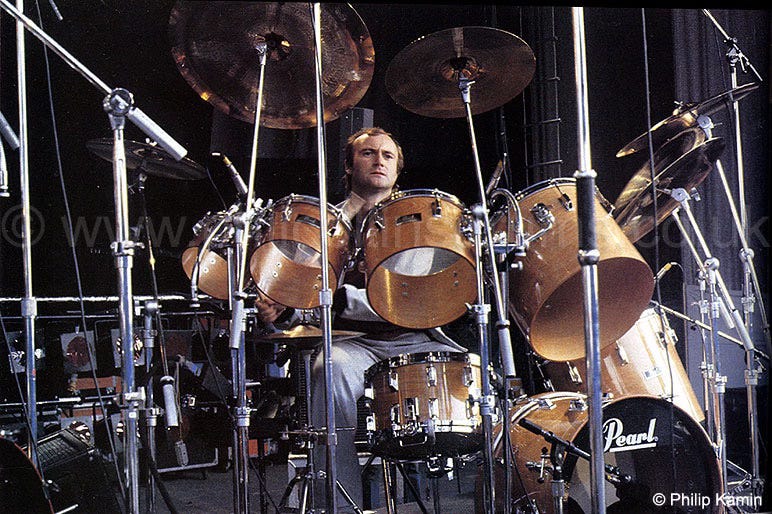
Pictured: Phil Collins and his iconic drumset configuration, but with Pearl drums instead of Gretsch.
Post-credits Scene
Since most readers of this blog aren’t compulsively focused on the minutiae of Frank Zappa’s career, here are the FZ references imbedded into today’s articles:
The blog intro is paraphrased from Zappa’s show introduction appearing on the song “Call Any Vegetable” from the 1971 original live album, “Just Another Band from L.A.” The actual theme of that concert was It’s So Fucking Great to be Alive, and the “questions, questions, questions” were flooding into the minds of “concerned young persons” rather than blog readers.
“Statiscal Density” is from Zappa’s introduction of the song “The Black Page #2” from the phenomenal 1978 live album, “Zappa in New York.” He is talking about how many notes were crammed into each bar of the song’s first version, “The Black Page Drum Solo/The Black Page #1.” Frank described “The Black Page #2” as the “easy, teenage New York version,” but it is nonetheless very difficult to play.
The use of the term “atrocities” is from Frank’s description of the on-stage audience interactions that the Mothers of Invention would perform in their early years, mainly during their residency at the Garrick Theatre in New York. The Velvet Underground would emulate those scenes during their stage shows, designed and choreographed by Andy Warhol.
“A little Elvis on the side” paraphrases the lyrics from the song “Dumb All Over” on FZ’s excellent double-LP “You Are What You Is” from 1981. The actual words are, “Dumb all over; a little ugly on the side.”