This Day in Music
Michael Fitzgibbon
There’s nary enough time for all the albums, and Elvis is once again at Studio B, on this day in music.
Preamble
There are a number of good albums celebrating anniversaries today, including David Gilmour’s eponymous debut solo album in 1978, Laurie Anderson’s “Home of the Brave” in 1986, and to a lesser extent, AC/DC’s 1986 soundtrack to the movie Maximum Overdrive, “Who Made Who.”
However, they’re all eclipsed by two monumental classics of the Rock and Roll oeuvre...
1. Absolutely Free
1967: Legendary American avant-garde rock band The Mothers of Invention release their second studio album, the psychedelic and art rock masterpiece, “Absolutely Free.” Highly complex musically, the record’s lyrics feature an abundance of contemporary political and social satire.
Following the departure of guitarist Eliot Ingber after the release of the band’s debut album, “Freak Out,” the remaining group, consisting of composer Frank Zappa (g; v), Ray Collins (v), Roy Estrada (bg; v), and Jimmy Carl Black (d; v) were joined by Billy Mundi (d), Don Preston (key), Bunk Gardner (ww), and Jim Fielder (g; p), who quit before the album was released, playing briefly with Buffalo Springfield and then becoming a founding member of Blood, Sweat & Tears.
The now-eight piece band was further augmented by several additional musicians and friends, including manager Herb Cohen, who does cash register sounds, and future Monty Python alumnus Terry Gilliam, who directed two Python features, Monty Python and the Holy Grail and Jabberwocky, and the classic movies Brazil and 12 Monkeys, among many others. He was one of several barroom voices on the track “America Drinks & Goes Home.” At the time, Gilliam was an animator, an artistic medium for which Zappa had great interest and admiration.
The LP is constructed as a series of interconnected movements, or as Zappa labeled them, “underground oratorios,” with each side of the record comprising a suite. Side A is titled “Absolutely Free,” while Side B is titled “The M.O.I. American Pageant.”
Zappa drew frequently upon the work of his favourite composers when writing the album, featuring “quotes” of pieces that moved him. Several Stravinsky themes are quoted in the song “Amnesia Vivace,” including “Ritual Actions of the Ancestors,” from Part II of The Right of Spring, and “Dance of the Adolescents” from Part I of that same ballet, and a bassoon reference to another Stravinsky ballet The Firebird. The fourth movement of Gustav Holst’s “The Planets,” titled “Jupiter, the Bringer of Jolly,” is quoted in the sax solo of “Invocation & Ritual Dance of the Young Pumpkin.” Finally, Zappa references himself, as the melody to “Duke of Prunes” is the love theme from his film score to the 1965 movie Run Home, Slow, directed by Ted Brenner using the name Tim Sullivan.
The opening track, “Plastic People,” which features a musical quote from the song “Louie, Louie,” a tune Zappa would explore frequently throughout his career, and reflects his love of classic R&B music, sets the lyrical tone for the album. Inspired by the name of a Czech band, Plastic People of the Universe, the song is a scathing statement against conformity and materialistic culture, including a knock at the President of the United States, Lyndon B. Johnson at the time.
From there, the social commentary is relentless, culminating with the penultimate track, “Brown Shoes Don’t Make It,” the title of which was a reference to LBJ committing the fashion faux-pas of wearing brown shoes with a grey suit, as reported by Time magazine.
Along the way, the listener is treated to an avant-garde, psychedelic, jazzy odyssey the likes of which were never-before heard in America. Receiving mostly strong reviews, AllMusic and the Encyclopedia of Popular Music rate it 5/5 stars, Rolling Stone reviewed it at just below 5-stars, and Robert Christgau of The Village Voice rated it a B-. The only poor review was from British music magazine Kerrang!, which gave it a 1-Star (out of five) rating.
In my opinion, “Absolutely Free” is a solid 10/10 album. My personal favourite sections are the mini-suite on Side A beginning with “The Duke Regains His Chops” and ending on “Soft Cell Conclusion,” and the aforementioned “Brown Shoes Don’t Make It” on Side B, though I adore every last second of this work from start to finish.
Not everyone in the record-buying public was ready for the sonic experience of the LP, but it nonetheless peaked at No. 41 on the Billboard 200, making the album very much a success.
The cover was designed by Cal Schenkel, who would be a long-time collaborator with Zappa, and features a stunning collage put together by FZ himself. It was produced by legendary Columbia Records and Verve Records producer Tom Wilson, who also produced Simon & Garfunkel, The Velvet Underground, and jazz musician Sun Ra.
I’m listening to “Absolutely Free” while I write this blog and I’m loving it! I highly recommend it to everyone.
2. Sgt. Pepper’s Lonely Hearts Club Band
1967: Legendary English rock band The Beatles release their eighth studio album, the seminal “Sgt. Pepper’s Lonely Hearts Club Band.” Once again produced by George Martin, the album is credited for advancing several aspects of production, including sound composition, psychedelic imagery, record sleeves, cover art, sound quality, recording techniques, and the inclusion of a thematic stream.
Critics were impressed with the sophisticated songwriting, the quality of production and graphic design, for bridging a cultural divide between art and pop music, and for the way in which it reflects the 1960’s counterculture and the interests of contemporary youth.
At the end of August, 1966, the band retired permanently from touring to focus on songwriting and recording. Following a few months of personal time, Paul McCartney was on a flight home to London and had an idea for a song about an Edwardian military band, which became the inspiration for the Sgt. Pepper concept.
Without an absolute deadline for completion of a new album, the band regrouped on November 24, 1966 at EMI Studios (now famously Abbey Road Studios) to begin production that would continue the technological experimentation and innovation featured on their previous LP, “Revolver.”
Early completed songs were “Penny Lane” and “Strawberry Fields Forever,” but were released as a Double-A side single in February 1967 at the behest of EMI, and held back from the album. The focus of the record was then loosely conceptualized around the Sgt. Pepper band.
Considered one of the first art-rock LP’s (along with “Absolutely Free” and some others), Sgt. Pepper is a work of British psychedelia and a progenitor of progressive rock.
Blending a range of styles and influences such as vaudeville, the circus, music hall, avant-garde, and Indian classical music, the record features 13 songs, including: The introduction tune, “Sgt. Pepper’s Lonely Hearts Club Band;” Ringo singing “With a Little Help from My Friends;” the oft-misunderstood “Lucy in the Sky with Diamonds;” a cross-generational lament, “She’s Leaving Home;” George’s ultra-psychedelic “Within You Without You;” another cross-generational song, “When I’m Sixty-Four;” the cheeky “Lovely Rita;” and if I don’t stop I’ll just list every track on the album!
The work concludes with the legendary “A Day in the Life,” featuring the infamous closing chord played on three separate pianos at once, sustaining their decay for over 40 seconds.
As may be expected for a premier work of The Beatles, it was an enormous commercial success. It hit No. 1 in Australia, Canada, Finland, Norway, Sweden, the U.K., the U.S., West Germany, and though I can’t find research to support this, I’m guessing it was No. 1 in every other country where rock music is a foundation of pop culture. Even reissues of the record in 1987, 2009, and 2017 went to No. 1 somewhere.
It is estimated that Sgt. Pepper has sold over 32 million copies worldwide, making it the 30th best-selling album of all time. Excluding greatest hits packages and multi-artist movie soundtracks, Sgt. Pepper is the 22nd-highest selling record of all time. However, it’s not the highest-selling Beatles LP. That honour goes to the 2000 compilation, “1.”
Music reviewers heaped universal critical acclaim on the album, with every major music magazine providing its highest-possible rating. Even Robert Christgau, then writing for Esquire, found the album worthy of Grade A.
One critic, however, Richard Goldstein, famously wrote a scathing review of the album for The New York Times, characterizing Sgt. Pepper as “…a spoiled child…” and “…an album of special effects, dazzling but ultimately fraudulent.” Another criticism he levied in the article was that it lacked substance lyrically, and tone overtook meaning, which he blamed on the use of echo and reverb, calling it posturing and a “put-on.”
Goldstein’s review touched-off a firestorm of controversy and backlash against him, deservedly so, and in response to the inundation of complaints, Goldstein’s home publication, The Village Voice, published a review by one of their staff writers, Tom Phillips, which praised the LP highly, stating it was “…the most ambitious and most successful record album ever issued.” Goldstein was kept busy for months justifying his review, which included an article in the Village Voice defending his opinion. It’s one thing to examine a recording in detail and find some flaws, but to fully dislike Sgt. Pepper? That’s just insane.
Obviously, I disagree wholeheartedly with Goldstein. I think Sgt. Pepper is a fantastic album; a bona fide 10/10. I’ve been listening to it my entire life, and during the whole time I wrote this part of the blog.
In Closing
It’s fascinating that unbeknownst to each other, The Mothers of Invention and The Beatles were creating two very distinct forms of psychedelia and art-rock, then releasing their respective accomplishments on the same day!
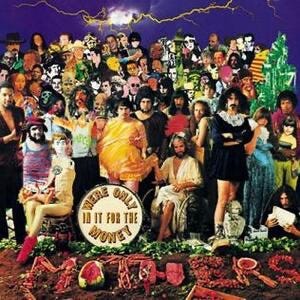
One interesting connection between the two bands: The Mothers of Invention album “We’re Only in It for the Money” famously includes an elaborate parody of the cover of “Sgt. Pepper’s Lonely Hearts Club Band” on its inside gatefold. It was relegated to that spot instead of being the front cover at the behest of Capitol Records, even though it was created with permission from Sir Paul himself. Subsequent re-releases of the record moved the parody to the front cover.
The Daily Elvis
1963: At RCA Studio B in Nashville, Elvis completes the hit song “(You’re the) Devil in Disguise” following a long and arduous recording session.
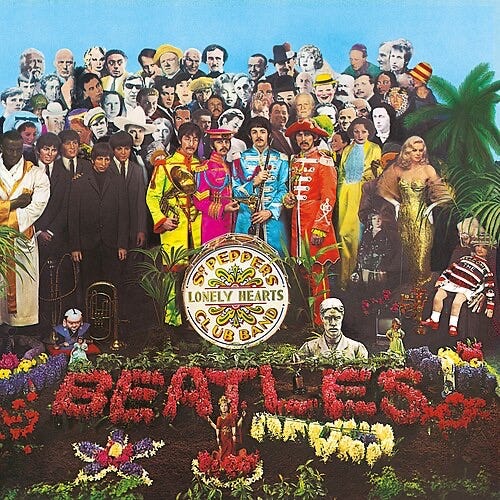
The front cover of “Sgt. Pepper’s Lonely Hearts Club Band” by The Beatles.