This Day in Music
Michael Fitzgibbon
A new machine makes the scene, Paul rhymes with rhymin’, and Elvis has them dancing in the aisles, on this day in music.
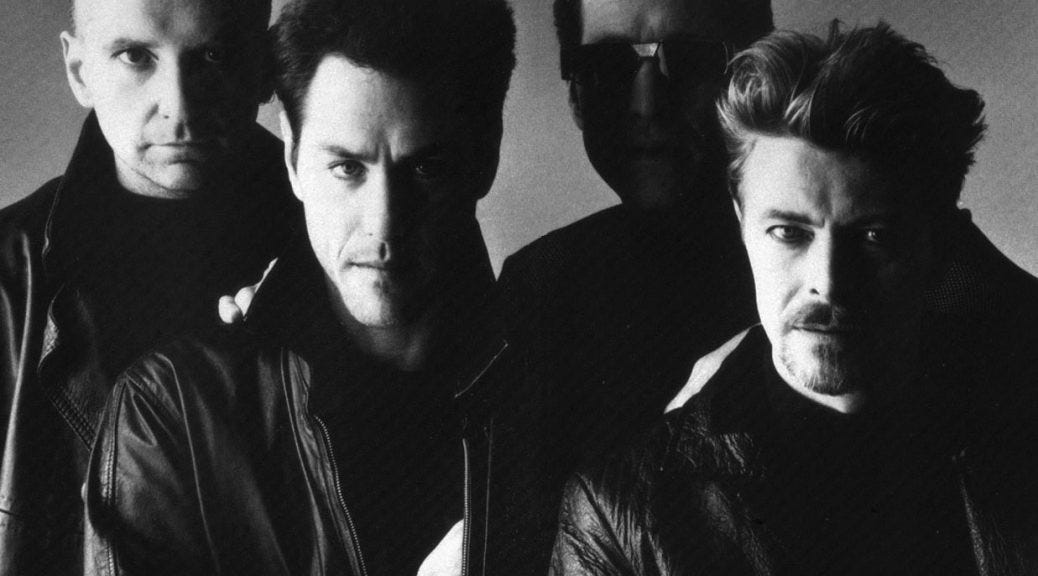
Tin Machine
1989: Short-lived Anglo-American hard rock band Tin Machine release their debut studio LP, a double-album simply titled, “Tin Machine.” Somewhat of a sonic assault, though not nearly as harsh as its critics claim (and what would be wrong with harsh anyway?), it’s not a sound for everyone, though there are indeed melodic moments.
Critics were split on the review of the record, with Spin Alternative Record Guide ranking it 1/10 and Record Mirror giving it 3-Stars (out of five) on the low end, but Robert Christgau grading it B- and AllMusic showing a rating of 4-Stars (out of five) on the high end.
Songs were written mostly as a collaboration by the band members, with impromptu lyrics that sang of love and current events, but with an overall pessimistic outlook. It features one cover song, John Lennon's “Working Class Hero.”
Three singles were released from the collection, including “Under the God,” which peaked at No. 4 on the Billboard Alternative chart, “Tin Machine,” with a non-album B-Side cover of Bob Dylan's “Maggie's Farm,” and “Prisoner of Love,” which did not chart.
Though “Tin Machine” reached No. 3 on the U.K. Albums chart, and was certified Gold in Canada and the U.K., it sold only 175,000 copies worldwide, one of which was purchased by me.
I like this album. Along with the singles, I particularly enjoy the tracks, “Heaven's in Here,” “Crack City,” “Amazing,” “Power of Love,” and “Baby Can Dance.” Tin Machine would release one more studio album in 1991, plus a live album in 1992, before disbanding that year.
There Goes Rhymin’ Simon
1973: “There Goes Rhymin' Simon,” the third studio album from legendary American singer-songwriter Paul Simon is released. Known for its two No. 1 singles, “Kodachrome” and “Loves Me Like a Rock,” every song on the album is wonderful, earning the universal acclaim heaped upon it by reviewers.
Reaching No. 2 in the U.S., No. 4 in the U.K., and No. 3 in Canada, it has been certified Platinum in the U.S., and ranks No. 267 on Rolling Stone's 500 Greatest Albums of All Time (c) 2003.
Ian Underwood
1939: Ian Robertson Underwood is born in New York City. Most famous as woodwind and keyboard player in several lineups of The Mothers of Invention, he continued to work with Zappa outside Mothers projects throughout the 1970's, including on the albums “Hot Rats,” “Chunga's Revenge,” “Over-Nite Sensation” “Apostrophe('),” and “Orchestral Favourites.”
He went on to play as a session musician for many famous pop and jazz artists, such as Captain Beefheart, Alice Cooper, Jean-Luc Ponty, Freddie Hubbard, Quincy Jones, famous TV and movie composer Lalo Shifrin, Chicago, Janet Jackson, and more.
Proficient as a synthesizer programmer, he has provided programming and performances on both woodwinds and keyboards for the music to over 35 film scores, among them, Avatar (2009), Field of Dreams (1989), Blade Runner (1982), and Marathon Man (1976). Ian also plays on the theme song to the 1980's TV show Knight Rider, and is featured on the historic Michael Jackson/Lionel Richie-written charity single, “We Are the World.”
You may not recognize the name Ian Underwood, but you've heard his music. Happy 86th Birthday, Ian!
The Friday Frank
1970: With a new lineup of The Mothers of Invention featuring ex-Turtles members Mark Volman (v), Howard Kaylan (v), and Jim Pons (bg), Frank Zappa performs at the University of Cincinnati’s Coffee House, in Cincinnati.
Some of the extra-musical entertainment provided that night, and forming part of the 1970 tour, included an early version of “The Groupie Routine,” a skit mocking American hotels, which would be more fully presented in the movie, 200 Motels; the M.O.I. Anti-Smut Loyalty Oath, a satirical pledge of purity making fun of American censorship culture; and the Beloit Sword Trick (originally debuted in Wisconsin), wherein Howard Kaylan portrayed a woefully incompetent magician’s assistant.
Musical highlights of the night consisted of the FZ guitar improvisation “Portuguese Fenders,” plus the MOI classics, “Pound for a Brown,” “King Kong,” which included several long solos by various band members, and “Easy Meat.”
The Daily Elvis
1956: Only 21 years old at the time, Elvis makes his debut in Iowa, performing at Veterans’ Memorial Stadium in Des Moines. Described as “atomic” by local news, and with “Heartbreak Hotel” sitting at No. 1 on The Top 100 (Billboard’s original music chart), the young Presley whipped the crowd into a frenzy.