This Day in Music
Michael Fitzgibbon
One Midwesterner goes south, legendary southerners go north, plus the future of Rock and Roll? And another Elvis compilation is released, on this day in music.
An Evening with The Allman Brothers Band
1995: Legendary American blues-rock band from the south, The Allman Brothers Band, release their 15th official album, “An Evening with The Allman Brothers Band: 2nd Set.” It can be misleading to separate ABB albums into studio and live streams, since many of their contemporary live albums include previously-unreleased tracks and are issued as new product, and many studio albums include live recordings. This album, however, is purely live.
In the summer of 1994, two tracks were recorded at the Walnut Creek Amphitheatre in Raleigh, North Carolina, then the band headed north for shows at the Garden State Arts Center (now PNC Bank Arts Center) in Holmdel, New Jersey, where the other five tracks were recorded. “In Memory of Elizabeth Reed” was recorded in 1992 at the R&R Club in Los Angeles.
The performance of “In Memory of Elizabeth Reed” was nominated for Best Pop Instrumental Performance at the 38th Grammy Awards, but lost. That's okay though, because the band did win Best Rock Instrumental Performance at those same Grammy Awards for their song, “Jessica,” from the same album. How “…Reed” constitutes pop, but “Jessica” constitutes rock, is something only the Recording Academy could explain, assuming they even listened to the songs in the first place. In reality they are both blues-rock.
Well-rated by critics for its excellent recordings of great performances of the group's most enduring songs, the double-LP makes for enjoyable listening. Other classic tracks featured include “Soulshine,” “Back Where It All Begins,” and “No One to Run With,” all taken from the previous year's standout studio album, “Where It All Begins.”
Young Man with a Horn
1952: Miles Davis records “Young Man with a Horn,” the second of three 10" LP's by Miles for iconic jazz label, Blue Note. Those three 10" records would eventually be re-released by Blue Note in 1956, but combined into two 12" LP's under the title “Miles Davis, Vol.1” & “Miles Davis Vol.2.”
Davis was struggling with a heroin addiction at the time, and it shows in his playing, earning only a 3-star review from The Encyclopedia of Popular Music, though it’s still an excellent performance by normal people standards.
Standout tracks include Miles's arrangement of Stan Getz's version of “Dear Old Stockholm,” the Dizzy Gillespie composition, “Would'n You,” and “How Deep is the Ocean,” by Irving Berlin, one of the many times Miles would draw from The American Songbook throughout his career.
Opening Act
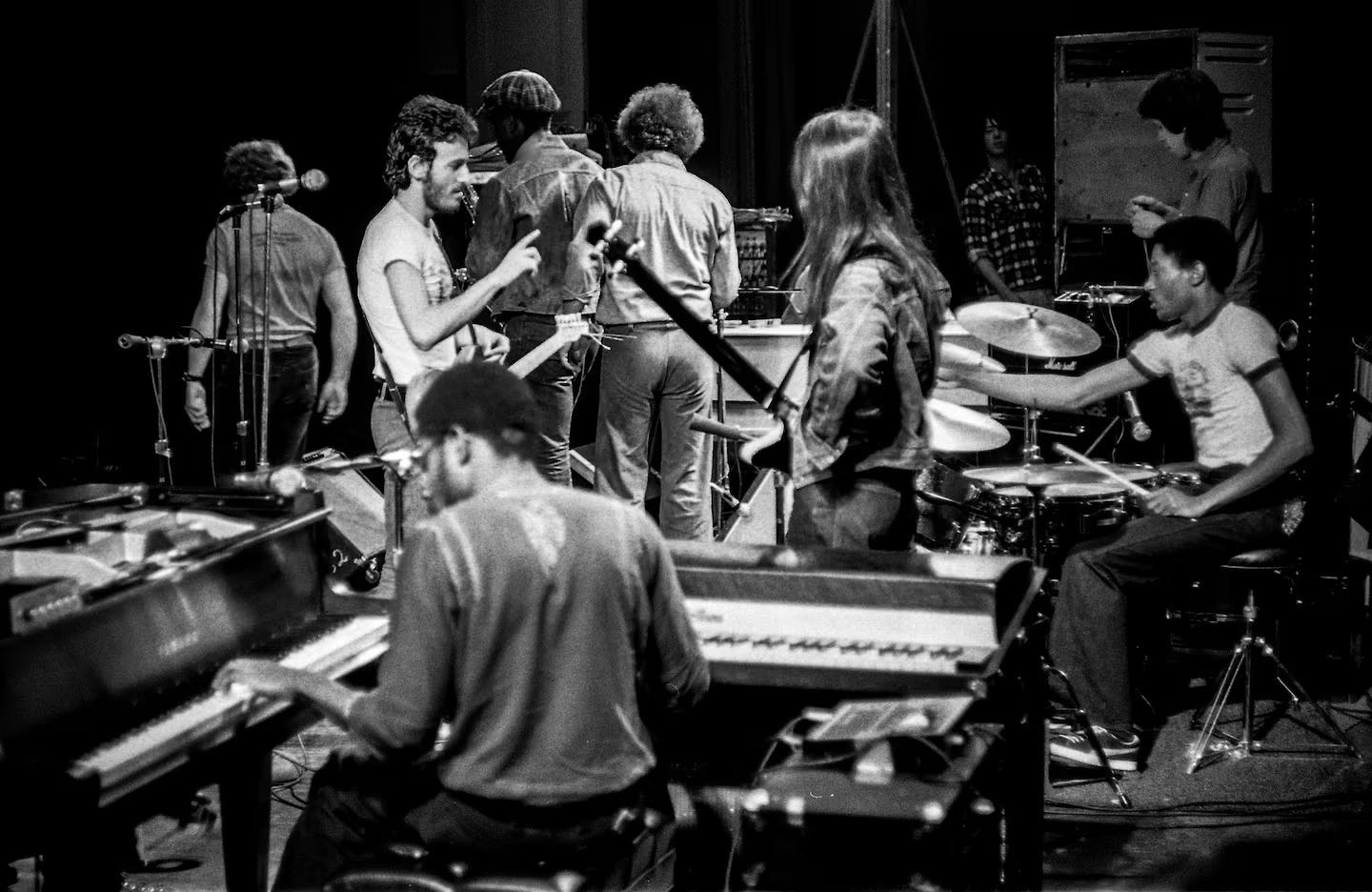
1974: Bruce Springsteen and The E. Street Band open for Bonnie Raitt at The Harvard Square Theatre in Cambridge, MA.
In the audience is Jon Landau of Rolling Stone magazine, who wrote of the performance, “I saw rock and roll's future and its name is Bruce Springsteen.” Landau would go on to co-produce every Springsteen album from 1975's “Born to Run,” to 1992's “Human Touch” and “Lucky Town,” separate albums released on the same day.
On drums at the time was Ernest “Boom” Carter, who had recently joined the band following the dismissal of original drummer Vini “Mad Dog” Lopez for fighting the band’s road manager. Carter would leave the band with keyboard player David Sancious to form jazz-fusion group Tone in August of 1974, and appears on only one studio-recorded song by the Boss, “Born to Run,” from the album of the same name.
Carter was replaced with Max Weinberg, who is the E. Street Band drummer to this day. Often appearing with Tone was American singer-songwriter and guitarist Patti Scialfa, who would marry Bruce Springsteen in 1991.
Big Daddy
1989: “Big Daddy,” the tenth studio album by American Rock and Roll singer-songwriter John Mellencamp, is released to positive reviews and commercial success. Issued during the time Mellencamp was phasing out of his stage name and back to his proper name, it's credited as John Cougar Mellencamp.
Peaking at No. 7 on the Billboard 200, the LP includes the big hit “Pop Singer,” which went to No. 2 in the U.S. and all the way to No. 1 in Canada. The best track on the album however, is the raucous cover of “Let It Out (Let It All Hang Out),” a 1967 song by The Hombres from Memphis, Tennessee. The Hombre's original is still the better version, but Mellencamp does it justice.
Mothers
1965: On what was Mother’s Day in 1965, Frank Zappa officially names his band “The Mothers.” At that time, great musicians were colloquially referred to as “motherfuckers” in jazz lingo, and “mothers” was the shortened term for that profanity. In early 1966, the executives at Verve Records refused to accept the name. Zappa therefore changed it to “The Mothers of Invention,” proving that necessity is indeed the mother of invention.
The Daily Elvis
2006: A compilation box set of classic Elvis songs titled “Legendary” is released by Sony International. The set includes 50 songs.