This Day in Classical Music
A This Day in Music Special by Michael Fitzgibbon
Dressed to the ninth, музыкально одарённый, and Karajan is in the studio, on this day in classical music.
Symphony No. 9
1824: Based on the Gregorian calendar, legendary German composer and pianist Ludwig van Beethoven debuts his ninth symphony, “Symphony No. 9 in D-minor,” Op. 125, at Theater am Kärntnertor (Corinthian Gate Theatre) in Vienna, Austria.
Beethoven co-conducted the Gesellschaft der Musikfreunde in Wien (Society of Friends of Music in Vienna) with composer, conductor, and violinist Michael Umlauf. Also performing was Musikfreunde’s SATB (soprano, alto, tenor, bass) chorale, featuring soloists Henriette Sontag (soprano), Caroline Unger (alto), Anton Haizinger (tenor), and Joseph Seipelt (bass).
Originally commissioned by the Philharmonic Society of London in 1817, Ludwig began writing sketches of the work later that year, deciding on the key and the inclusion of the chorale. He composed the piece beginning in the fall of 1822, completing the autograph manuscript in February of 1824.
Beethoven had to be convinced to debut the symphony in Vienna. Having decided he’d fallen out of favour with the musical trend of the Viennese at the time, which in his opinion preferred the likes of Rossini and other Italian operatic composers, he wanted to release No. 9 in Berlin, as soon as possible after the completion of the manuscript. Enamoured by the gracious appreciation shown by the Viennese in their attempts keep him in Austria, he decided to debut the work in Vienna afterall.
The evening’s program began with “The Consecration of the House,” Op. 124, an overture he wrote in 1922 for Vienna’s new Theater in der Josefstadt (Theatre in Josefstadt, a district of Vienna), then three parts of “Missa Solemnis in D-major,” Op. 123, from 1819, “Kyrie,” “Credo,” and “Agnus Dei,” first performed in Saint Petersburg only the month before. To conclude the event, “Symphony No. 9,” becoming the closer in modern parlance, with “Ode to Joy” being the grand finale.
Those fortunate enough to be in attendance were absolutely enthralled by the performance. Essentially deaf at the time, Beethoven had to be turned around by Umlauf to face the audience and experience its rapturous applause. Spectators were well-aware that they had witnessed an historical event.
One of the most recognizable pieces of music in the tonal system, No. 9 is considered by nearly every composer, musician, and listener to be a masterpiece of Western classical composition. To this day it is among the most frequently-performed symphonies, with 289 presentations at Carnegie Hall, for example. Brahm’s “Symphony No. 1 in C-minor,” Op. 68, is first at Carnegie Hall with 356 performances, and Beethoven’s “Symphony No.5 in C-minor,” Op. 67, is second, presented 328 times. Brahm’s first symphony is referred to by some as “Beethoven’s Tenth.”
“Symphony No. 9’s” fourth movement is known as “An die Freude” (Ode to Joy) and features the four vocal soloists in the parallel key, D-major. Friedrich Schiller wrote the poem in 1785, revised it in 1803, and Beethoven added additional text between 1822 and 1824, as part of his composition.
Ode to Joy is the only aspect of the piece that was subject to criticism, and even at that, it is somewhat controversial. Giuseppe Verdi, a legendary composer of Italian operas, commented following the debut, “No one will ever approach the sublimity of the first movement, but it will be an easy task to write as badly for voices as in the last movement.” An overly harsh critique, but many critics and scholars grant that the fourth movement has weaknesses.
Personally, I think the fourth movement is spectacular, but I’m neither scholar nor legendary operatic composer.
Notable performances of Symphony No. 9 include the British premier on March 21, 1825 by the commissioners, the Philharmonic Society of London, conducted by Sir George Smart; the American premier on May 20, 1846 by the New York Philharmonic conducted by Englishman George Loder; the inaugural season of the Bayreuth Festspielhaus (Bayreuth Festival Theatre) in 1872, with Richard Wagner conducting the house orchestra; and an international orchestra comprised mainly of East and West Germans conducted by Leonard Bernstein at Konzerthaus Berlin during Chirstmas of 1989 to celebrate the fall of the Berlin Wall. Bernstein changed the chorale text from An die Freude to An die Frieheit (Ode to Freedom).
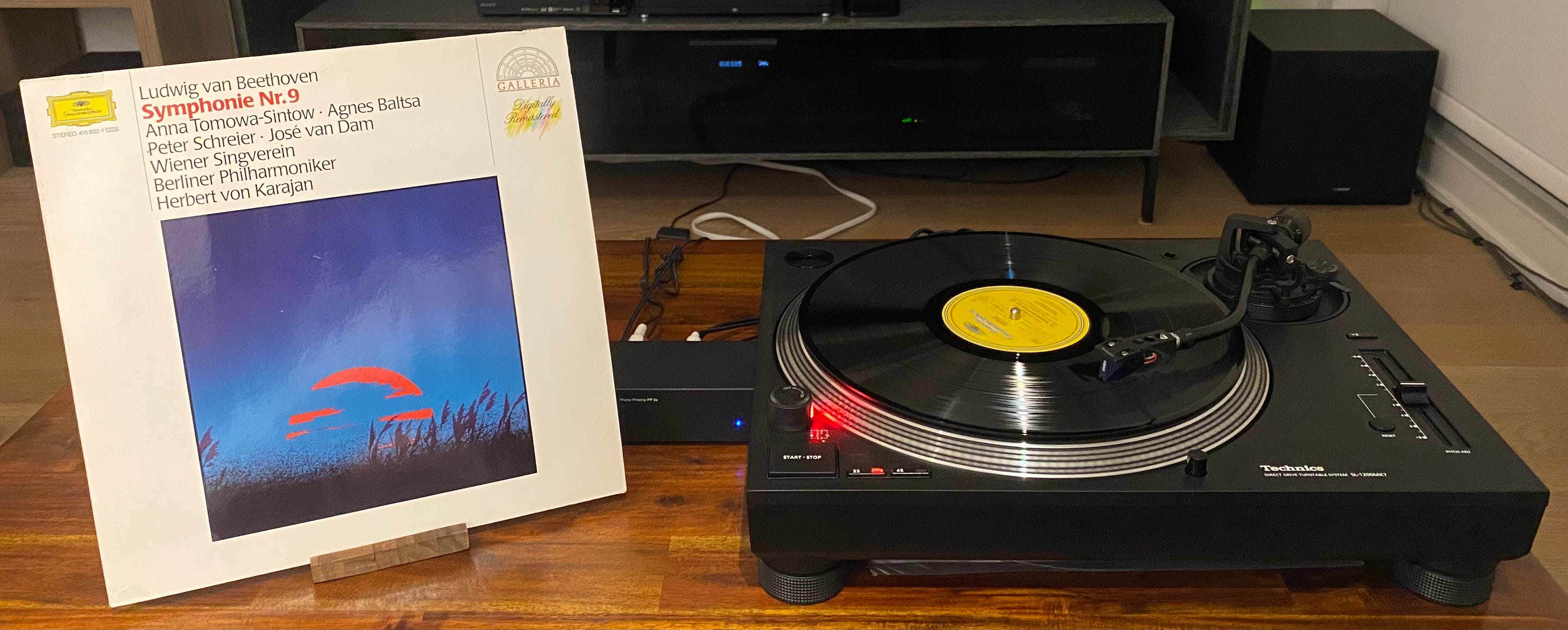
My favourite recorded version of the symphony remains the 1977 Deutsche Grammophon release by the Berliner Philharmoniker (Berlin Philharmonic) with the Weiner Singverein (Vienna Singing Society). Conducted by legendary Austrian maestro, Herbert von Karajan, it features soloists Anna Tomowa-Sintow (soprano), Agnes Baltsa (alto), Peter Schreier (tenor), and José van Dam (baritone.) Though there are better recordings, this is the one that has been with me for most of my life, and holds a special place in my heart.
I’ll be celebrating the 202nd anniversary of “Symphony No. 9” by playing that record today. Probably twice.
Pyotr Ilyich Tchaikovsky
1840: Legendary Russian romantic composer, pianist, flautist, and conductor, Pyotr Ilyich Tchaikovsky is born in Votkinsk, Russia. The first Russian composer to achieve international fame, he was a child prodigy, and has composed some of the most popular classical works in history.
Examples of his well-known pieces include “The Year 1812, Solemn Overture,” Op. 49 in E♭-major, in 1880 (i.e. 1812 Overture); “Piano Concerto No. 1,” in B♭-minor, Op. 23, in 1874-1975; “Violin Concerto in D-major,” Op. 35, in 1878; “Romeo and Juliet,” an overture-fantasy based on the play by William Shakespeare, written and modified between 1870 and 1880, which has two alternate catalogue numbers rather than an opus number, TH42 and ČW39; the opera “Eugene Onegin,” Op. 24, premiered in 1879; and the ballets “Swan Lake,” “The Sleeping Beauty,” and “The Nutcracker,” among his estimated 169 works.
Though Tchaikovsky suffered terrible stage fright, he fought his way through it to be a world-class conductor. For the inauguration festival of Carnegie Hall (then, simply Music Hall) he conducted the New York Symphony Orchestra on four nights:
May 5, 1891: “Festival Coronation March in D-major,” TH50 / ČW47, originally commissioned by the City of Moscow for the coronation of Tsar Alexander III in 1883;
May 7, 1891: “Orchestral Suite No. 3 in G-major,” Op. 55, for piano and orchestra, written in 1884 and first performed in Saint Petersburg on January 24, 1885;
May 8, 1891: He presented two chorale works featuring the Oratorio Society of New York, “Our Father,” a sacred piece normally part of his “Liturgy of St. John Chrysostom,” Op. 41, and “Legend,” Op. 54, a song written in 1883 for voice and piano; and
May 9, 1891: The grand finale of his residency, “Piano Concerto No. 1 in B♭-minor,” Op. 23, with piano soloist and composer Adele aus der Ohe, a highly-talented musician and friend of Tchaikovsky from The Kingdom of Hanover, now Lower Saxony in Germany.
On November 6, 1893, Tchaikovsky died of cholera from drinking bacteria-laden water that had not been properly boiled at a restaurant in Saint Petersburg. He was only 53 years old.
Controversy surrounds his death as some historians allege he was forced to kill himself by drinking the contaminated water during a cholera epidemic. The reasoning goes that Tchaikovsky was too well-educated and intelligent a man to not have verified that his water had indeed been boiled, given the outbreak in Saint Petersburg. The motive of his coercive murderers was to silence a growing scandal about his sexual attraction to a young nobleman.
Had Tchaikovsky lived a full life, there is no doubt that he would have produced many more great works. For me, the opening theme from “Piano Concerto No. 1” is among the most beautiful melodies ever composed.
The Daily Karajan
1976: The third day of recording sessions by the Berlin Philharmonic conducted by Herbert von Karajan are held in Berlin. The orchestra, which had been performing Tchaikovsky Symphonies No. 4, 5, and 6 that season, was committing the pieces to master tapes for LP production by Deutsche Grammophon.
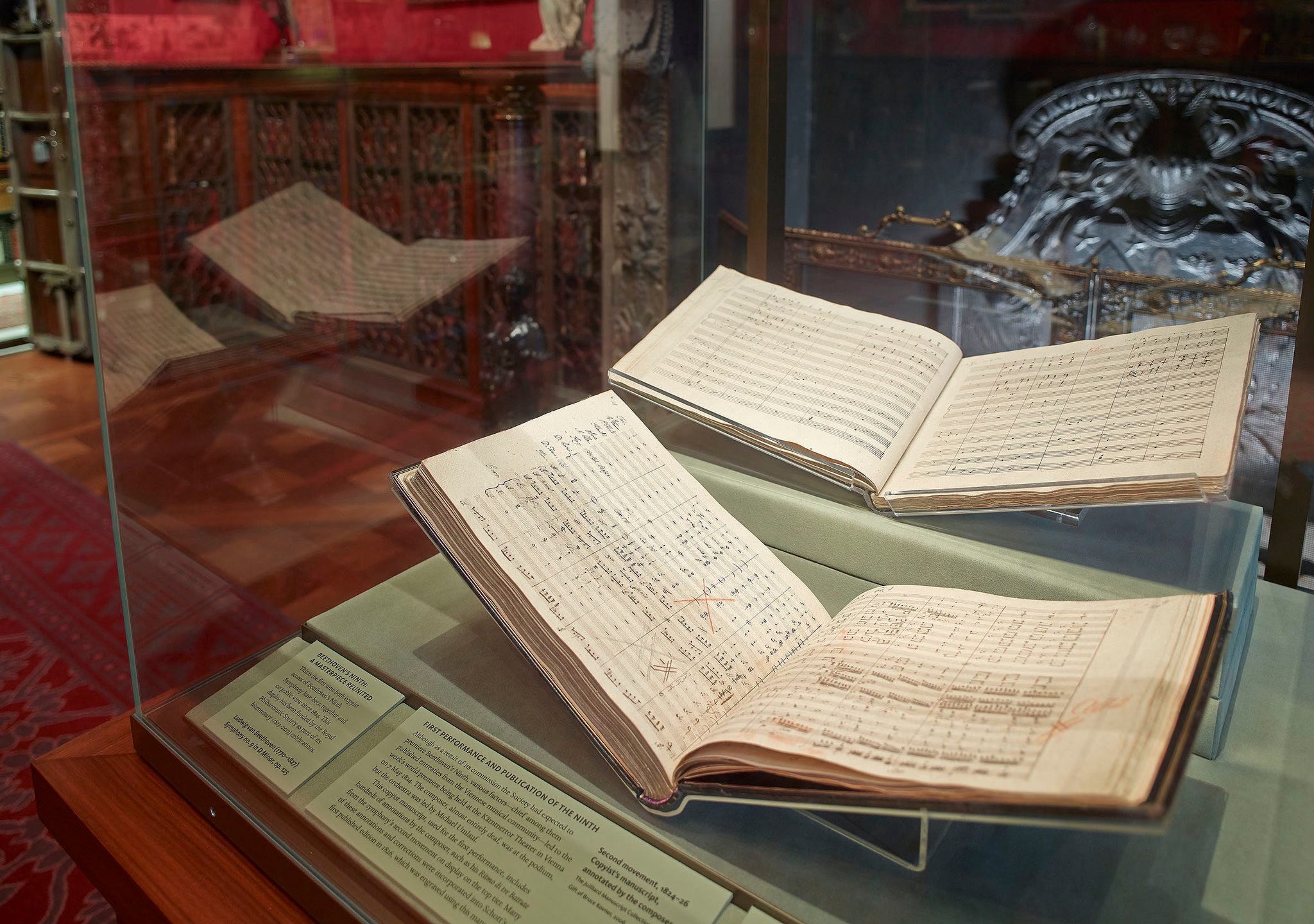
The Juilliard Manuscript of Symphony No. 9 in D-minor, made by a copyist and including Beethoven’s own handwritten notes and corrections from 1824, on display at The Morgan Library & Museum, New York in 2013. This copy was used to conduct the orchestra at the inaugural performance in Vienna.
Video Clip: Piano Concerto No. 1, Berlin Philharmonic conducted by Herbert von Karajan, with soloist Alexis Weissenberg on piano, from 1967.